Unraveling the mystery of the vortices: what is hidden in Venus's clouds?
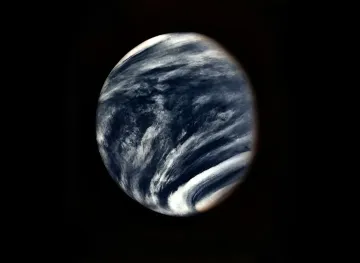
In August 2026, the scientific community gained a new perspective on one of the most intriguing mysteries of the Solar System — the nature of the dark spots in Venus's atmosphere. For a long time, astronomers and planetary scientists could not precisely determine which substances are responsible for the powerful absorption of ultraviolet radiation at altitudes of 60–70 kilometers. A new study published this year offers a compelling hypothesis: these "absorbers" may be the result of the chemical transformation of cosmic dust constantly falling onto the planet. According to calculations, polycyclic aromatic hydrocarbons (PAHs) and iron compounds play a key role in this process, changing their structure as they descend into the dense layers of the atmosphere.
Chemical conveyor: from the mesosphere to the lower clouds
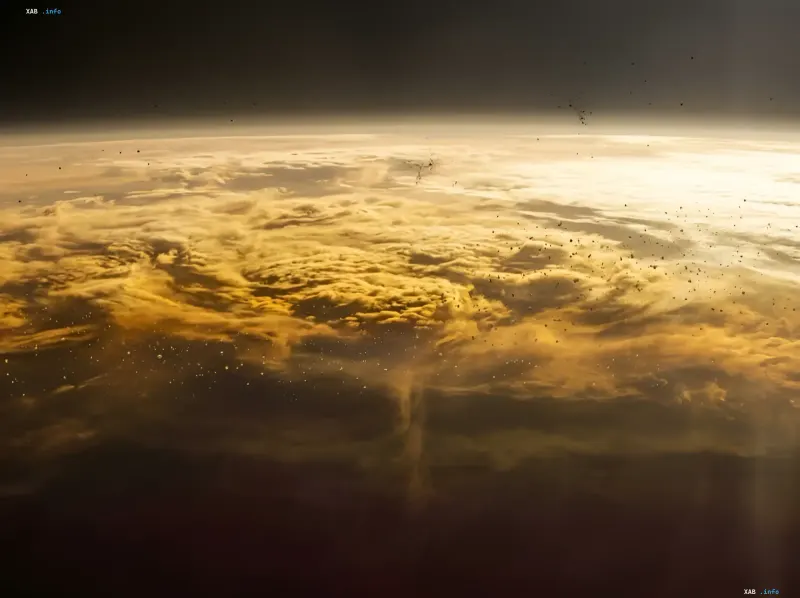
Scientists have developed a model describing the sequential change in the composition of substances at different altitudes. At the cloud tops, in the 60–70 km region, the model best aligns with a mixture of PAHs containing 5 to 10 aromatic rings and iron(III) chloride. As particles descend lower, into the decomposing aerosol layers, the chemical composition changes: smaller PAHs with 3–4 rings and iron sulfate appear. Below the cloud layer, under extreme temperature conditions, PAHs with 5–10 rings dominate again, but now in combination with iron hydroxysulfates. This scenario explains how a single source — cosmic dust — can generate various absorbers at different levels of the atmosphere.
The role of cometary dust and the timeframe of the process
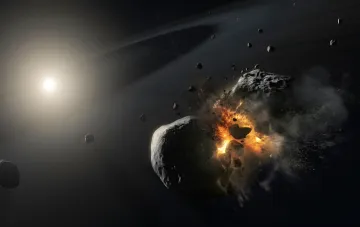
The proposed mechanism begins with particles of cosmic dust that constantly bombard Venus's atmosphere. Upon entering the atmosphere, part of the organic material, including PAHs, is preserved in particles that have not undergone strong heating, while iron is released from dust heated by friction. In the clouds, sulfuric acid reacts with these substances, and below the cloud layer, the compounds decompose further. Calculations show that obtaining the observed concentrations of carbon and iron requires a relatively short time by geological standards: about 600 years to accumulate carbon in the upper part of the clouds and 3,000 years for iron. This confirms the theory of a single scenario for the origin of the absorbers.
Future missions and hypothesis verification
Although the theoretical model appears convincing, direct measurements are necessary for its final confirmation. The authors of the study point to planned missions, such as "Morning Star," which will be able to verify the presence of PAHs and insoluble organic matter directly in the planet's atmosphere. Scientists also note that the origin of these substances from the surface of Venus itself is unlikely: volcanic sources of organic carbon and iron are unconfirmed, and volatile iron compounds are unstable under surface conditions. Thus, cosmic dust remains the main candidate for the source of the mysterious absorbers.