In August 2026, the scientific community received confirmation that humanity possesses real tools to protect against cosmic threats. A group of researchers, who published their work in the prestigious The Planetary Science Journal, demonstrated the effectiveness of a scenario using nuclear weapons to neutralize killer asteroids. Modeling showed that physical contact is not required to destroy or deflect a cosmic body 160 meters in size, which radically changes approaches to planetary defense.
Abandoning physical contact: a new paradigm of protection
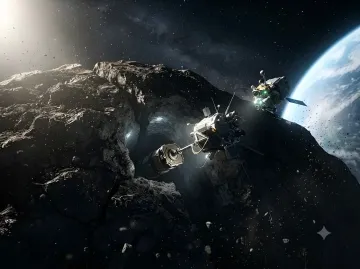
Traditional concepts of asteroid defense, such as drilling wells to install charges inside the body or detonating directly on the surface, face insurmountable technical difficulties. Asteroids rotate chaotically in a vacuum, and landing a spacecraft in an emergency situation, let alone drilling into unstable rock, is practically impossible. Physicists have found that the explosive device does not need to touch the cosmic body at all. The key factor becomes the detonation distance, allowing the energy of the explosion to be used for the mass destruction of the asteroid's structure.
Modeling results: the power of X-ray radiation
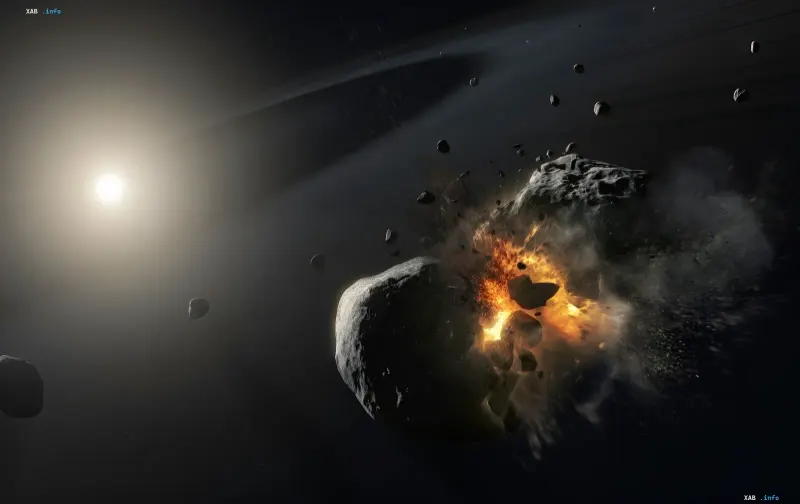
The basis for the simulation was the structure and density of asteroid Bennu, as well as data on the Chelyabinsk and Abu Hanein meteorites. During the experiments, the detonation of a 1-megaton warhead was tested at various distances from the surface. When detonated 10 meters from the surface, about 98.2 percent of the material sustained critical damage, and 97 percent of the debris exceeded the asteroid's second cosmic velocity, leading to its disintegration. When the detonation distance was increased to 25 meters, the area covered by X-rays increased, resulting in a larger area of destruction in a shorter period of time.
Computational power and calculation complexity
Creating an accurate model of such a collision required colossal computational resources. The complex simulation, covering just 145 milliseconds of interaction, required 59 days of continuous computation on 1680 computer processors. Researchers note that this is an important step in developing real planetary defense protocols in case dangerous objects are detected. The data obtained allows engineers to design systems capable of functioning in a critical situation without the need for complex docking.