Researchers at the Lawrence Livermore National Laboratory (LLNL) have presented a series of three-dimensional simulations demonstrating how a nuclear explosion could alter the trajectory of or completely destroy a potentially hazardous asteroid. The work, reported by RBC-Ukraine with reference to Interesting Engineering, has become one of the most detailed numerical experiments in the field of planetary defense and provides international organizations with specific mathematical tools for decision-making in extreme scenarios.
From kinetic impactor to the nuclear option
Unlike most global threats, an asteroid collision can be prevented if it is detected early enough. In 2022, NASA already demonstrated the effectiveness of a kinetic impactor: the DART mission probe intentionally crashed into the asteroid Dimorphos and changed its orbit. However, to stop giant bodies or in conditions where only months remain before a potential impact, the energy of a conventional spacecraft is insufficient. It is within this 'window' that a nuclear charge, capable of delivering orders of magnitude more energy to the object, is considered a last resort, yet physically viable measure.
Methodology: from 1,500 calculations to volumetric models
To evaluate the realism of the nuclear scenario, LLNL astrophysicists utilized the specialized Spheral computational code. Before moving to three-dimensional simulations, the team compared more than 1,500 one-dimensional calculations with data from the verified Ares model. Only after confirming the accuracy of the algorithm did the researchers proceed to volumetric 3D models that took into account body geometry, rock density, and radiation parameters.
What happens during detonation: evaporation and fragmentation
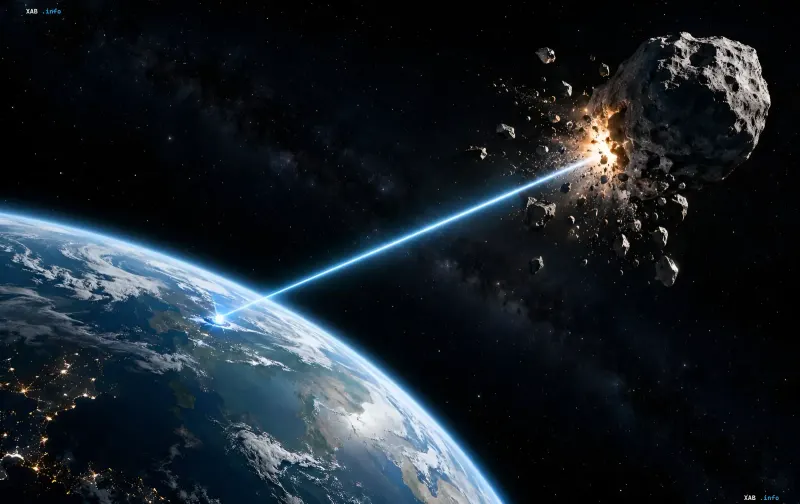
During the experiment, scientists simulated a detonation near a complexly shaped asteroid 160 meters in diameter. The simulations varied the distance to the detonation site and the density of the rock itself. X-ray radiation from the explosion leads to the rapid evaporation of the upper layers of the body, and the subsequent vapor pressure causes fragmentation—the asteroid breaks apart into numerous fragments that scatter in different directions.
Main conclusion: no 'stone rain'
The key result of the study is that after detonation, the asteroid fragments acquire sufficient velocity to disperse into open space. None of the fragments retain a trajectory directed toward Earth, which rules out the scenario of a massive 'stone rain' upon the planet's surface. The resulting 3D models, as intended by the authors, will allow international planetary defense organizations to calculate in advance how, where, and with what yield a nuclear charge should be applied if the planet is genuinely threatened by a cosmic catastrophe.
Context and prospects
The LLNL study fits into a broader program of preparation for hypothetical threats from near-Earth objects. Although the probability of a large asteroid colliding with Earth in the coming decades is assessed as extremely low, having verified numerical models and refined detonation protocols reduces uncertainty at the moment when decisions must be made under tight deadlines. The work emphasizes that the nuclear option remains not a 'Plan B', but the final echelon of defense, resorted to only when kinetic and gravitational methods are exhausted.