The Solar System is not a static structure but a dynamic one, in which gravitational interactions, stellar evolution, and the motion of celestial bodies constantly reshape the conditions for planetary existence. Astronomers, whose review was published in BBC Sky At Night Magazine and summarized by RBC-Ukraine, formulated four main scenarios that, in the long term, could destroy Earth and the very architecture of the Solar System. None of them is science fiction: each is grounded in confirmed physical models and observational data.
Impacts by Space Objects: a Mechanism Proven by Evolution
Collisions with asteroids and comets are not a hypothetical threat but a documented mechanism of mass extinctions. The impact of an asteroid about 10 kilometers in diameter in the Yucatán Peninsula region 66 million years ago led to the disappearance of the dinosaurs and the extinction of the vast majority of species on the planet. Modern calculations show that even an object the size of a multi-story building, traveling at a speed of around 50,000 km/h, could trigger an explosion with a yield comparable to an atomic bomb and destroy infrastructure within an 8-kilometer radius. If an object 11–13 km in diameter were to strike Earth, the consequences would be global: tsunamis, tons of dust and aerosols lifted into the stratosphere, and multi-year blocking of sunlight, leading to a sharp cooling of the climate.
Gravitational Instability and the Slow Drift of the Moon
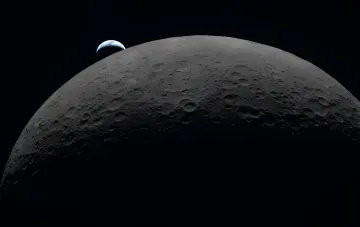
According to astronomers' estimates, the Solar System will retain its current configuration for at least 40 million years. However, in the more distant future, gravitational interactions between the gas giants could knock the inner planets out of their orbits. In particular, under the influence of Jupiter, Mercury's orbit has a probability of becoming significantly elongated within 5 billion years, making it unpredictable. At the same time, the Moon is slowly moving away from Earth at a rate of about 3.8 centimeters per year. The satellite's gravity creates ocean tides that slow down the rotation of our planet; the lost angular momentum is compensated by the acceleration of the Moon and its further recession. This process, though imperceptible on human timescales, will radically change the conditions on Earth's surface on a geological timescale.
Climate and Seasonal Consequences of Losing Lunar Stability
The Moon's recession will trigger a chain of ecological and climatic consequences. Weakened tides will destroy coastal ecosystems — mangrove forests, salt marshes, and coral reefs — and will also alter the ocean currents that shape global weather. More critically, the Moon stabilizes the tilt of Earth's axis, keeping it within narrow limits. If this stabilization is disrupted, the familiar cycle of seasons may disappear or become chaotic, rendering the planet's climate uninhabitable for most modern ecosystems. Moreover, in about 600 million years the Moon will be so far away that it will no longer fully cover the solar disk, making total solar eclipses impossible.
The Death Throes of the Sun: the Finale of the Solar System
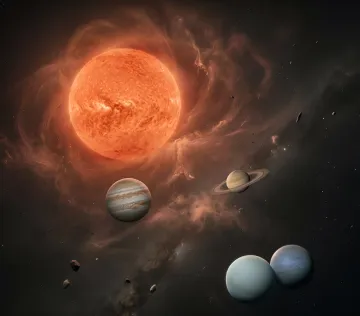
In approximately 5 billion years, the supply of hydrogen — the main fuel for thermonuclear fusion — will be exhausted in the Sun's core. The star will begin to contract, heat up, and fuse helium into heavier elements, while thermonuclear reactions in its outer layers will cause it to expand to the size of a red giant. In this process, the Sun will engulf and evaporate Mercury and Venus. Even if Earth avoids direct engulfment, its atmosphere and surface will be completely destroyed by the intense radiation of the expanding star. Having lost nearly half its mass, the Sun will weaken its gravitational pull, causing the orbits of the surviving giant planets to move roughly twice as far out compared to their current values. Thus, the Solar System in its familiar form will cease to exist.
What Humanity Is Already Doing for Protection
Despite the scale of the scenarios described, some of the threats are already within the zone of control. Thanks to NASA's observation programs and the successful testing of the DART (Double Asteroid Redirection Test) system, humanity has proven that the trajectory of a dangerous asteroid can be altered artificially. This does not eliminate the long-term threats associated with the Sun's evolution and gravitational instability, but it turns the asteroid threat from absolute fatality into a manageable risk. Astronomers emphasize: none of the four scenarios will occur within a foreseeable future for civilization, yet understanding them is essential for forming a realistic picture of Earth's place in the Universe.