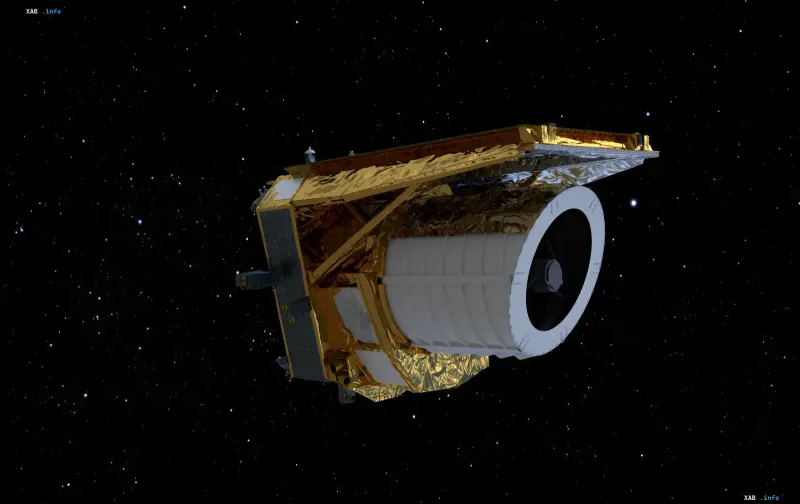
The European space telescope Euclid has made its first independent astronomical discovery within the Solar System: the spacecraft detected a previously unknown comet, which after verification received the official designation C/2026 S1 (Euclid). This was reported by RBC-Ukraine with reference to an official material from the European Space Agency (ESA). The find came as a surprise to the scientific team, since the telescope was not built to search for passing asteroids and comets, but for fundamental cosmological research, and it was precisely this "serendipitous luck" that provided scientists with a new object to study.
An Unplanned Discovery
Euclid's primary mission is to study the shape and motion of billions of galaxies up to 10 billion light-years away from Earth in order to uncover the nature of dark matter and dark energy. To avoid stray light from interplanetary dust, asteroids, and comets that interfere with sensitive deep-space images, the telescope is intentionally pointed at patches of the sky far from the plane of the Solar System. Furthermore, Euclid takes snapshots and does not return to the same areas repeatedly, making the accidental capture of a moving object against the deep sky background a rare and valuable occurrence. According to Naked Science, the images in which the comet was found were taken as part of a deep survey of the northern sky from September 16 to 24, 2026.
How a Graduate Student Spotted the Comet in the Images
The atypical object was first noticed by Mikko Pöntinen, a graduate student at the University of Helsinki, using software he developed: algorithms detected a blurred trail from a fast-moving object on the images. Subsequent analysis confirmed the presence around it of a foggy cloud of dust and gas—a coma, which is characteristic of active comets. After cross-referencing catalogs and confirmation by the Minor Planet Center (MPC) of the International Astronomical Union on October 8, 2026, the object was officially registered as C/2026 S1 (Euclid). The algorithms captured the comet in five different image sets—totaling 16 exposures in Euclid's deep northern survey field.
Unusual Orbit and Comet Parameters
At the time of discovery, the comet was located at a distance of about 1.3 billion kilometers from Earth, which roughly corresponds to the distance from the Sun to the region between the orbits of Jupiter and Saturn. The unusual motion geometry is noteworthy: the comet does not travel in the plane of the planets, but effectively "perpendicularly" upward from the Sun, describing an arc over the Solar System. The object's full orbital period around the Sun is estimated in thousands of years, pointing to its origin from the distant regions of the planetary system.
A Precedent for Future ESA Missions
Comets are icy and dusty remnants from the era of the Solar System's formation 4.6 billion years ago. Studying their composition helps scientists understand what materials planets formed from and where water and primordial organic building blocks on Earth came from. Detecting a comet at such an early stage and at a significant distance from the Sun proves that Euclid is capable of searching for new objects in the deep sky. This creates an important precedent for cooperation with future ESA research missions, in particular the Comet Interceptor spacecraft, which plans to intercept pristine comets during their first approach to the center of the planetary system.