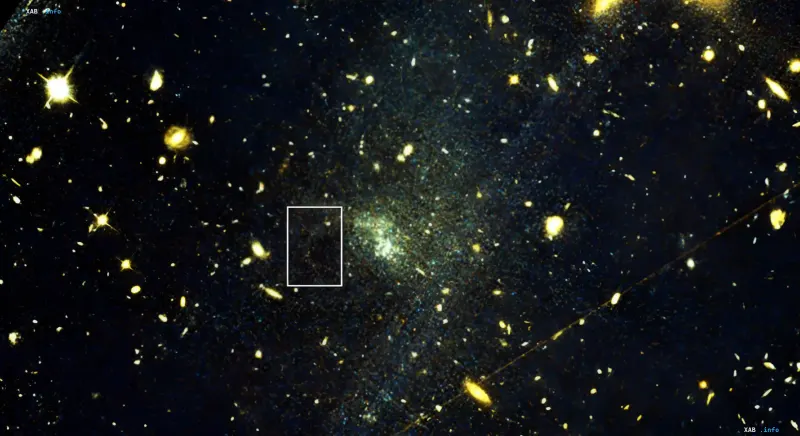
On August 19, 2026, the astronomical community marks a breakthrough in the study of the Universe's structure. An international team of researchers has recorded the existence of a stellar stream associated with a globular cluster beyond our galaxy for the first time. This unique structure was discovered in the ultra-diffuse galaxy UGC 9050-Dw1 — an object characterized by extremely low surface brightness. This discovery not only expands the boundaries of our knowledge of cosmic structures but also opens up fundamentally new possibilities for mapping the distribution of dark matter in other galactic systems.
Technological breakthrough in observing ultra-diffuse galaxies
Stellar streams are elongated structures consisting of stars that gradually leave their original globular cluster under the influence of the galaxy's gravitational forces. Their motion preserves information about the system's dynamic history, allowing scientists to reconstruct the properties of the gravitational field. However, detecting such structures beyond the Milky Way has always been an extremely difficult task. The stream consists of very faint sources, and in the case of the galaxy UGC 9050-Dw1, observations are further complicated by the low brightness of the galaxy itself.
Ultra-diffuse galaxies, to which UGC 9050-Dw1 belongs, represent a special class of objects with low stellar density. Until now, studying their internal structure and mass distribution has been hindered by a lack of bright markers. The discovery of a stellar stream in such a galaxy became possible thanks to the use of advanced data processing methods and highly sensitive observation instruments.
A new tool for investigating dark matter
The main value of this discovery lies in the ability to use stellar streams to estimate the distribution of dark matter where it cannot be observed directly. Dark matter does not emit or absorb light in quantities sufficient for direct observation, so its presence is determined solely by its gravitational effect on visible matter.
Stellar streams provide an additional method for this: since their structure is formed by the motion of stars in the galaxy's gravitational field, it can serve as a kind of "trace" of the distribution of invisible mass. Until now, the capabilities of this method were limited to observational data on the Milky Way. Now, astronomers have confirmation that this tool works in other galaxies as well.
Mass distribution in UGC 9050-Dw1
The authors of the study used observational data of the stream in UGC 9050-Dw1 to obtain new estimates of the galaxy's mass distribution. Calculations showed a significant content of dark matter, which is consistent with previous estimates of this galaxy and general concepts regarding the properties of ultra-diffuse galaxies. At the same time, the method of measurement itself was fundamentally new: the tool previously used to study dark matter in the Milky Way was tested in another galaxy for the first time.
These results confirm that ultra-diffuse galaxies indeed contain large amounts of dark matter, making them ideal objects for studying the nature of this mysterious substance. The method of analyzing stellar streams allows for obtaining more accurate data on mass distribution than traditional methods based on observing the motion of individual stars or gas clouds.
Prospects for future research
Astronomers will now be able to search for similar streams in other galaxies and compare their properties. This is particularly important for ultra-diffuse galaxies, where there are few bright stars and traditional methods of estimating mass distribution are more difficult to apply. Observations of UGC 9050-Dw1 show that stellar streams can become an independent tool for studying dark matter beyond the Milky Way.
The authors expect that the number of detected streams will increase significantly with the start of new observations by the Euclid and Nancy Grace Roman Space Telescope observatories. This will allow the method to be applied to a larger number of galaxies of different types and to compare the distribution of dark matter in various galactic systems. It is expected that in the coming years we will see significant progress in understanding the structure and evolution of galaxies thanks to these new research tools.