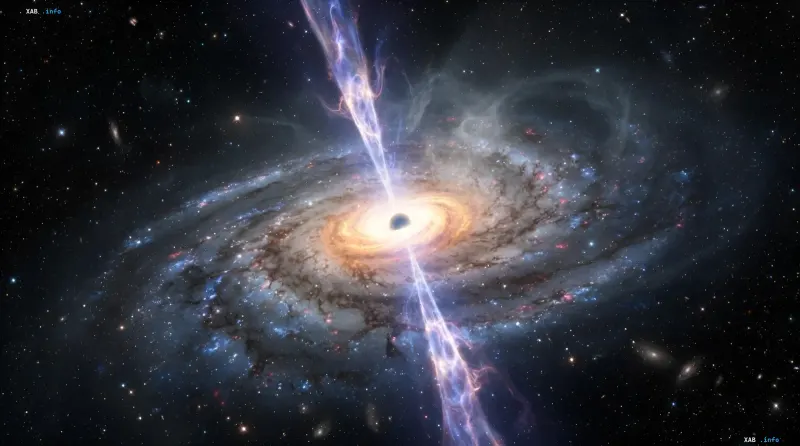
Astronomers have found new evidence that supermassive black holes can fundamentally influence the evolution of entire stellar systems. Jets of hot plasma erupting from the vicinities of actively feeding black holes are capable of affecting surrounding gas at distances of hundreds of thousands of light-years. As a result, the gas loses its ability to cool effectively, which directly impacts the processes of new star formation.
Large-scale study of cosmic jets
The study was conducted by an international team of scientists led by Sanchayeeta Borthakur from Arizona State University and Namrata Roy from the Raman Research Institute in India. The results of this work were published in the prestigious scientific journal The Astrophysical Journal Letters. Around almost every large galaxy lies a huge halo of diffuse gas, which serves as a strategic reservoir of material for future generations of stars. Gradually, this gas should cool, sink to the center of the galaxy, and serve as building material, but in practice, this process is regulated by central objects.
Heating mechanics and the role of the DESI survey
To understand how black holes suppress star formation, researchers analyzed data from hundreds of galaxies, combining the DESI optical survey and LOFAR radio observations. Scientists looked for weak hydrogen emission in the circumgalactic medium. It turned out that in the directions of plasma outflows—jets—the emission is significantly stronger than in other areas. This proves that jets act as directed spotlights, transferring colossal energy to matter at the furthest outer boundaries of gas clouds.Contradictory data
Despite compelling evidence of general gas heating by jets, debates persist in the scientific community regarding the precise mechanisms of energy distribution. Some researchers note that the distribution of cooler gas around galaxies remains relatively uniform, casting doubt on models of complete material displacement. In addition, new observations of individual giant jets exceeding the size of the Milky Way dozens of times reveal complex interaction patterns that do not yet fully fit into classical simulations of galactic evolution.