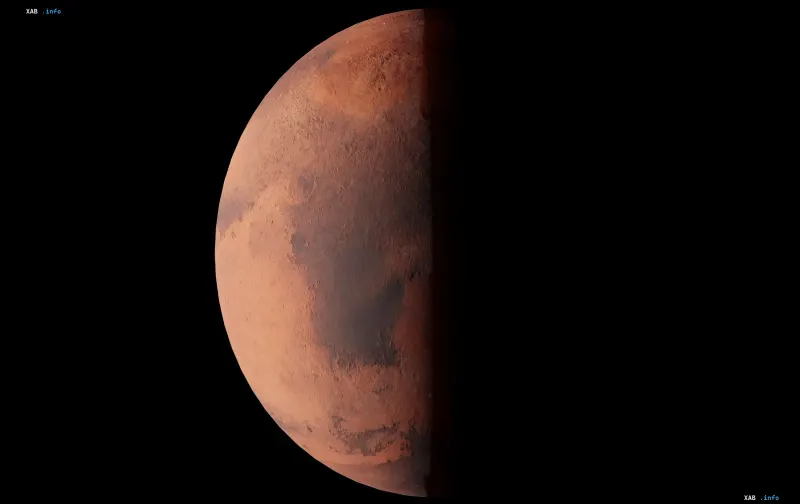
In August 2026, the scientific community was given a unique opportunity to look into the past of Mars, filling one of the most significant gaps in the planet's geological record. The key to the mystery was the meteorite NWA 13441, found in Northwest Africa. The study of this stone, conducted by a team of scientists led by Professor Ethan Baxter from Boston College, allowed for the reconstruction of events that occurred 1.27 billion years ago — an era about which very little was known until now.
Recovering the Lost Era
For a long time, the chronology of Mars' geological development resembled a puzzle with missing central pieces. Scientists had data on the oldest rocks (over 4 billion years old) and relatively young samples (younger than 600 million years). However, a huge time gap — from 600 million to 2.4 billion years ago — remained in the shadows. It is precisely this "dark age" of the Red Planet's history that is now being clarified thanks to NWA 13441. The meteorite, blasted off the surface of Mars by a powerful asteroid impact and wandering in orbit for millions of years, became the missing link connecting the planet's ancient past with its later history.
Chemical Paradox: Antiquity in Young Rocks
The find surprised researchers not only with its precise age but also with its unique chemical composition. A rare metal, neodymium, was discovered within the meteorite. Typically, this element is characteristic of the oldest cosmic rocks, formed at the dawn of the Solar System more than 4.5 billion years ago. The presence of neodymium in a stone that is 1.27 billion years old creates an interesting paradox: a combination of ancient and young rocks in a single sample. This discovery confirms the hypothesis that the interior of Mars has remained practically untouched by geological processes since the planet's formation.
Geological Memory: Mars vs. Earth
A comparative analysis of the Martian meteorite and terrestrial rocks revealed fundamental differences in the evolution of the planets. On Earth, tectonic activity, continental drift, and the constant recycling of underground rocks erase ancient geological memory. Unlike our planet, Mars lacks the mechanism of mobile tectonic plates. Thanks to this "geological freezing," the Red Planet has preserved unique information about its formation and development within its interior, which is now available for study through meteorites such as NWA 13441.
Contradictory Data
Although the discovery of NWA 13441 is recognized as a scientific breakthrough, there are various viewpoints within the community regarding the interpretation of its composition. On one hand, most researchers, including Professor Baxter, agree that the presence of neodymium indicates the stability of the Martian mantle. On the other hand, some geologists suggest that the chemical composition could be the result of local processes related to volcanic activity of that period, rather than global interior stability. For now, the final verdict will be rendered after the completion of a detailed analysis of all samples found in the same series.
New Horizons for Research
Currently, scientists are continuing in-depth study of the unique NWA 13441 sample. The goal of further research is to obtain a more complete picture of Mars' volcanic activity during the era 1.27 billion years ago. Understanding how volcanism developed during this period could provide keys to deciphering climate changes on the planet and, possibly, point to periods when conditions favorable for life may have existed on Mars. As Ethan Baxter noted: "The characteristics of this meteorite turned out to be absolutely unexpected," which opens new horizons for Martian science.