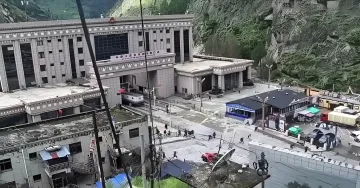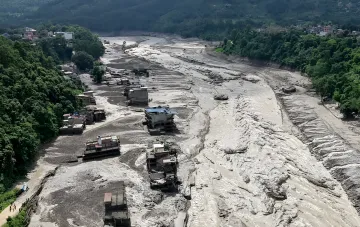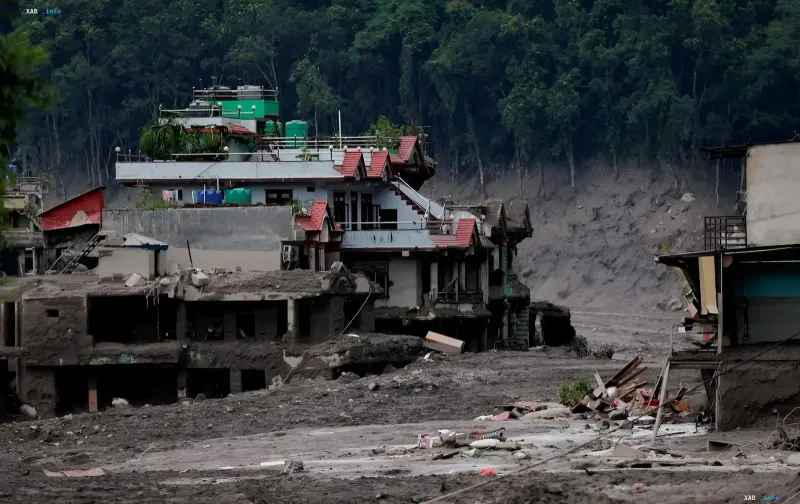
Early Wednesday morning, August 26, a sudden flood accompanied by a landslide struck the Rasuwa district north of Nepal's capital, Kathmandu. According to the latest reports, at least 18 people have died, around 400 are missing, and entire villages were swept away by the disaster. Preliminary information suggests the catastrophe was triggered by an earthquake that caused an avalanche of melting snow to surge into the Bhote Koshi river. Verified footage shows the current sweeping away a bridge and destroying multi-story buildings.
Scale of the damage and the search-and-rescue operations
According to the Nepali army, search-and-rescue operations are being carried out on both sides of the border; so far 88 people have been rescued. Nepali army spokesperson Rajaram Basnet reported efforts to save 115 people from the village of Mailung. The Ministry of the Interior warned of the likelihood of heavy losses in the settlements of Timur, Syabrubese and Betrawati. Several districts downstream of the Bhote Koshi have been placed on heightened alert: roads, communications and power supplies have been disrupted, and the main road to Kathmandu has been closed.
Among the missing are tourists and security personnel
The Nepal Tourism Board reported that efforts are ongoing to locate 291 tourists and 93 Nepali citizens, including guides, who were in the flood zone. Among them are 12 travelers from the United Kingdom, as well as citizens of the United States, Malaysia, South Africa and India. Nepal's Foreign Minister Shishir Khanal told parliament that 26 police officers, nine armed police and 44 soldiers are missing. Nepali officials are expecting "huge losses," and Chinese state media, which controls Tibet, report significant casualties.
Blow to infrastructure and energy
The disaster damaged the Trishuli hydropower project. Nepal's Ministry of Energy stated that 430 MW of electricity supply was affected, mainly from hydropower plants. According to Reuters calculations, this is more than 12% of the country's total 3.2 GW of hydropower capacity. Bridges and multi-story buildings have been destroyed, and the threat to the population along the Bhote Koshi riverbed persists.
Cause of the disaster and the threat of a secondary flood
Preliminary data indicate that the flood was the result of an earthquake that triggered the release of melting snow into the Bhote Koshi river. Authorities have warned of a possible second flood: a debris dam has formed upstream on the Nepal–China border, so people along the riverbanks are urged to remain vigilant. Chinese President Xi Jinping called for "full-scale" searches for the missing, as well as for strengthening monitoring and early-warning systems to avoid secondary disasters.
Contradictory data
There are inconsistencies in the statements of the parties and in the reports that are important to take into account. First, the number of missing people varies: some reports cite "around 400," while the sum of the separately named groups — 291 tourists and 93 Nepali citizens — gives 384 people, and including 79 missing police and army personnel the total exceeds 460. Second, the number of deaths ("at least 18") is preliminary and, by officials' own admission, may rise. Third, the cause of the flood has so far been given only "based on preliminary information" and is linked to an earthquake, although the mechanism of the meltwater release requires confirmation. It is worth emphasizing separately: the powerful magnitude 7.1 earthquake in Japan mentioned in the context at the end of July is a separate event, unrelated to the flood in Nepal.
Government response and international reaction
Search-and-rescue operations are being coordinated on both sides of the border, and the Chinese side has announced a transition to "full-scale" operations and the strengthening of early-warning systems. Nepali authorities are focused on evacuating residents of riverside villages and restoring disrupted communications. The situation remains dynamic, and final data on casualties and damage will be refined as rescue teams make progress.