On November 17, the presentation of the winning project for the monument to the victims of the communist dictatorship in Germany took place in Berlin. The winning design is «Formation and Breakthrough» (Formation und Aufbruch), developed jointly by the Leipzig architectural firm ZILA, artists Bea Meyer and Michael Grzesiak, and the Dresden landscape architecture firm Rehwaldt Landschaftsarchitekten. The Bundestag decided to create the memorial back in 2019, but the specific appearance of the monument has only become known seven years later. Federal authorities are allocating five million euros for the competition and project implementation.
Geometry of Power and Metaphor of Resistance
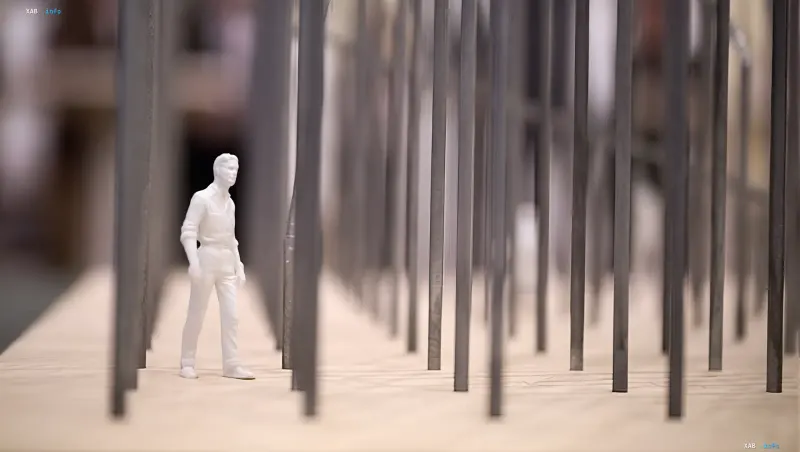
The composition will consist of 121 ten-meter-long aluminum stelae placed on a square plaza in eleven rows of eleven elements each. The authors explain the strict geometry of the monument as a metaphor for totalitarian power: people stand at attention, line up in columns, and march in step. At the same time, some of the stelae will be bent and twisted — these specific elements symbolize resistance to the dictatorship and the fight for freedom. As visitors move between the structures, the appearance of the composition will change: depending on the viewing angle, the straight rows transform into an interlacing of metal lines. Visitors will be able to walk between the stelae, and the space will also be accessible for wheelchair users.
Inscriptions, Names, and Place in the Urban Landscape
Inscriptions recording specific forms of repression will appear on the stelae: «deprivation of citizenship», «separation of families», «imprisonment», «forced labor», and others. An information board will be installed near the memorial. The memorial will be erected in Spreebogenpark, in close proximity to the Federal Chancellery, the Bundestag building, and the Central Station. Thus, the monument will occupy one of the most politically significant and heavily trafficked locations in the capital. The memorial will immortalize the memory of people who were persecuted, deprived of rights, imprisoned, and killed first in the Soviet occupation zone of Germany and later in the GDR.
"A Painful Gap in the Culture of Remembrance"
German Minister of State for Culture and Media Wolfram Weimer stated that the memorial will fill a "painful gap" in the country's culture of remembrance. According to him, the monument must also counter attempts to downplay the crimes of the SED dictatorship — the Socialist Unity Party of Germany, which ruled the GDR. Director of the Federal Foundation for the Study of the SED Dictatorship Anna Kaminsky emphasized that the new monument is intended to show young people and visitors to Germany what courage the fight for freedom required. Chairman of the Union of Associations of Victims of Communist Dictatorship Dieter Dombrowski, whose family saw six of eight children imprisoned, said that for survivors, such a memorial will serve as psychological support and recognition of what they endured. According to DW, Germany already has over 900 memorials, museums, and other sites commemorating the dictatorship in the Soviet occupation zone and the GDR.
Dispute Over the Cornerstone Laying
A political dispute has already arisen around the future monument. According to the dpa news agency, the Union of Associations of Victims of Communist Dictatorship (Union der Opferverbände Kommunistischer Gewaltherrschaft) supported the creation of the memorial, but stated that its representatives will not participate in the cornerstone laying ceremony if representatives of the Berlin government led by the Left Party (Die Linke) are present. The Union considers this party to be the political successor to the SED, which ruled the GDR, and this circumstance makes joint participation in the official event impossible for the victims of the dictatorship.
Construction Timeline
According to the official announcement by the Department for Culture, construction is scheduled to take place in 2027–2028. However, during the project presentation, Wolfram Weimer expressed hope that the work would be completed as early as the autumn of 2027. Thus, by the 80th anniversary of the founding of the GDR (October 7, 1949), the memorial could already be completed and open to the public.