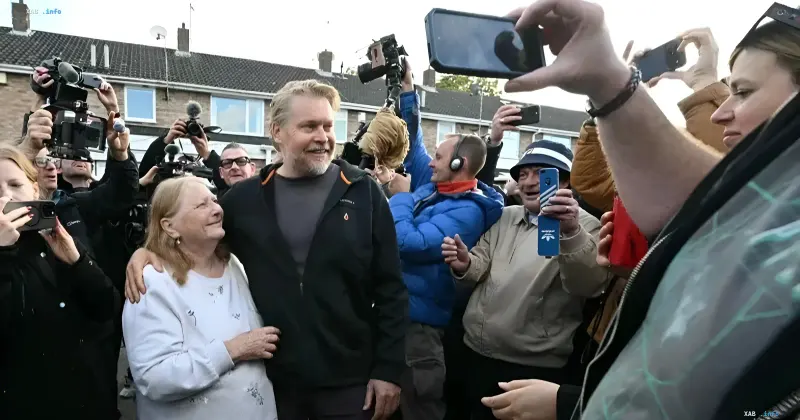
On November 2 in northern England, former British paratrooper Karl Bushbi embraced his weeping mother, thereby completing a walking journey around the world that lasted 28 years. The event took place against the backdrop of a dense crowd of journalists and onlookers with cameras and smartphones: Bushbi, returning home with streaks of gray hair and a weathered face, became the center of attention both at home and in global media. At a subsequent press conference, he confessed that "it was almost a shock to see his mother again after such a long break," noting that over these years, "we have all changed a lot."
From the Parachute Regiment to a straight line on the map
In his youth, Bushbi served in the Parachute Regiment of the British Army. Following his divorce, in his own words, he drew a straight line on a world map and set off on a round-the-world walking journey, taking with him only a tent, a few hundred dollars, and a cheap plastic camera. The journey started on November 1, 1998, in Punta Arenas, Chile. Along the way, he covered more than 50,000 km on foot, passing through four continents and 30 countries to return home.
A route without ships and planes
A key condition of the trip was the exclusion of any means of transport: Bushbi refused ships, planes, and other vehicles. He crossed shifting ice sheets across the Bering Strait, swam across the Caspian Sea and the English Channel. According to him, he swore not to return until he completed the journey entirely on foot. The path was dangerous: the traveler recounted that he was detained in Panama and Russia, and threatened with weapons in Mexico.
Plans for 10 years turned into almost three decades
Initially, Bushbi planned to dedicate about 10 years to the adventure, but the actual timeframe proved incomparably longer. The 2008 financial crisis exhausted funding from donors, the 2020 COVID-19 pandemic, and numerous bureaucratic obstacles when crossing international borders interrupted the route for many years. Bushbi himself clarified that out of the 28 years on the road, he actually walked a lot for only about 15 years. He started the journey at age 29 and returned home at 57.
Monotony and post-finish plans
Describing the difficult sections, the traveler spoke about monotony: "I have to be in deserts, and the landscape doesn't change day after day, week after week. It drives me a little crazy. The Arctic is the same." In the final days of the trip, he shared concerns about completing the route and did not know what he would do next. Now back home, the former paratrooper plans to tour England with speaking engagements in the coming weeks and is a co-author of a documentary about his adventure.