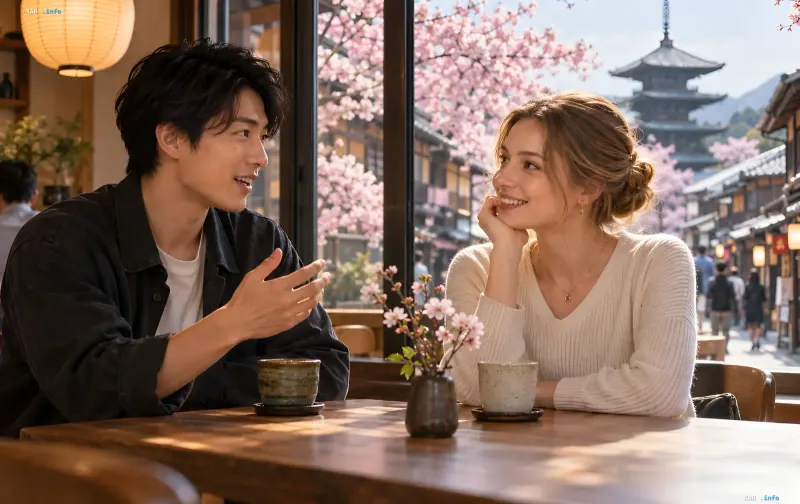
The Japanese language and communication culture are full of nuances that can easily confuse a foreigner. A habitual "yes" in conversation does not always mean agreement, and words with identical pronunciations can denote completely different things—from rain to sweets, from chopsticks to a bridge. Kateryna Filenko, a Japanese language teacher who observed local behavior rules firsthand during a study trip to Japan, discussed these and other communication features in an interview with Styler.
The tradition of nodding along: Listening, but not necessarily agreeing
According to Kateryna Filenko, the tradition of nodding along is deeply rooted in Japanese communication: the interlocutor responds to words with brief affirmative answers to show they are attentively listening and understanding what is being said. However, the teacher emphasizes that such a reaction should not be automatically taken as confirmation that the person shares your opinion or agrees with your proposal. "I would say that in Japan there is a tradition of 'nodding along'. They do this to show they are listening to you. But do they really agree with what you are saying? You need to be careful with that," she explained.
Identical sounds, different meanings
Another difficulty for foreigners is words that sound identical or very similar but have different meanings. In such cases, context, pronunciation, and intonation become decisive. That is why during a conversation it is important to pay attention not only to individual words but also to the general context, especially in business communication, where agreements and decisions can depend on the interlocutor's response. At the same time, according to the teacher's observations, a mistake made by a foreigner does not necessarily become a problem: in her subjective impression, Japanese people do not expect perfect fluency from people who are just learning the language. "As for Japanese words, since we are foreigners, in my subjective impression—they do not expect much from us," Kateryna said.
Punctuality as part of the first impression
The peculiarities of communication in Japan begin even before the first word is spoken. During the study trip, delegation members constantly warned each other about the importance of punctuality: there, it is better to arrive not just on time, but about five minutes before the scheduled meeting. Even a slight delay, according to the teacher, can affect the first impression of a person. "We might be late in Ukraine, but for the Japanese, it is better to arrive on time, 5 minutes before the start. Even before the first word spoken, you can already make an impression," she explained. She also drew attention to respect for personal space and the fact that friendly communication and business meetings involve different linguistic and communicative nuances.
Public space rules: From smoking to cleanliness
In public places, Japanese people follow a number of behavioral rules: in particular, they do not eat on the go and do not sit on the ground or stairs. Attitude toward smoking deserves special attention—according to Kateryna's observations, people do not smoke in public places and streets, except for specially designated zones. The teacher was also struck by the fact that there are no traditional trash cans on the streets of Japanese cities: the principle is to leave a place clean after yourself or even make it cleaner so that other people can use it comfortably. "They have a rule—leave cleanliness behind or make it even cleaner so others can use it after you. This applies everywhere—in the park, in the restroom, in a cafe. And yes, they don't have trash cans on the street," she said. Tourists, according to her, should be prepared to take their trash with them rather than leave it in public spaces. She shared an example from her trip: when she forgot a bag of shopping in a store and returned about 15 minutes later, the items were still in the exact same place.
Discipline as a matter of safety
Japanese discipline, in Kateryna Filenko's view, should not be explained solely by politeness or good manners: a significant portion of the rules is related to safety. Japan regularly faces earthquakes, tsunamis, and abnormal heat, so rules of conduct in the subway and other public spaces help avoid danger and prevent endangering others. During the trip, Kateryna herself witnessed an earthquake in Kumamoto: the delegation's accommodation had hard hats and information booklets with emergency instructions, and participants were advised to keep a certain amount of cash on hand in case communication failed after an earthquake.