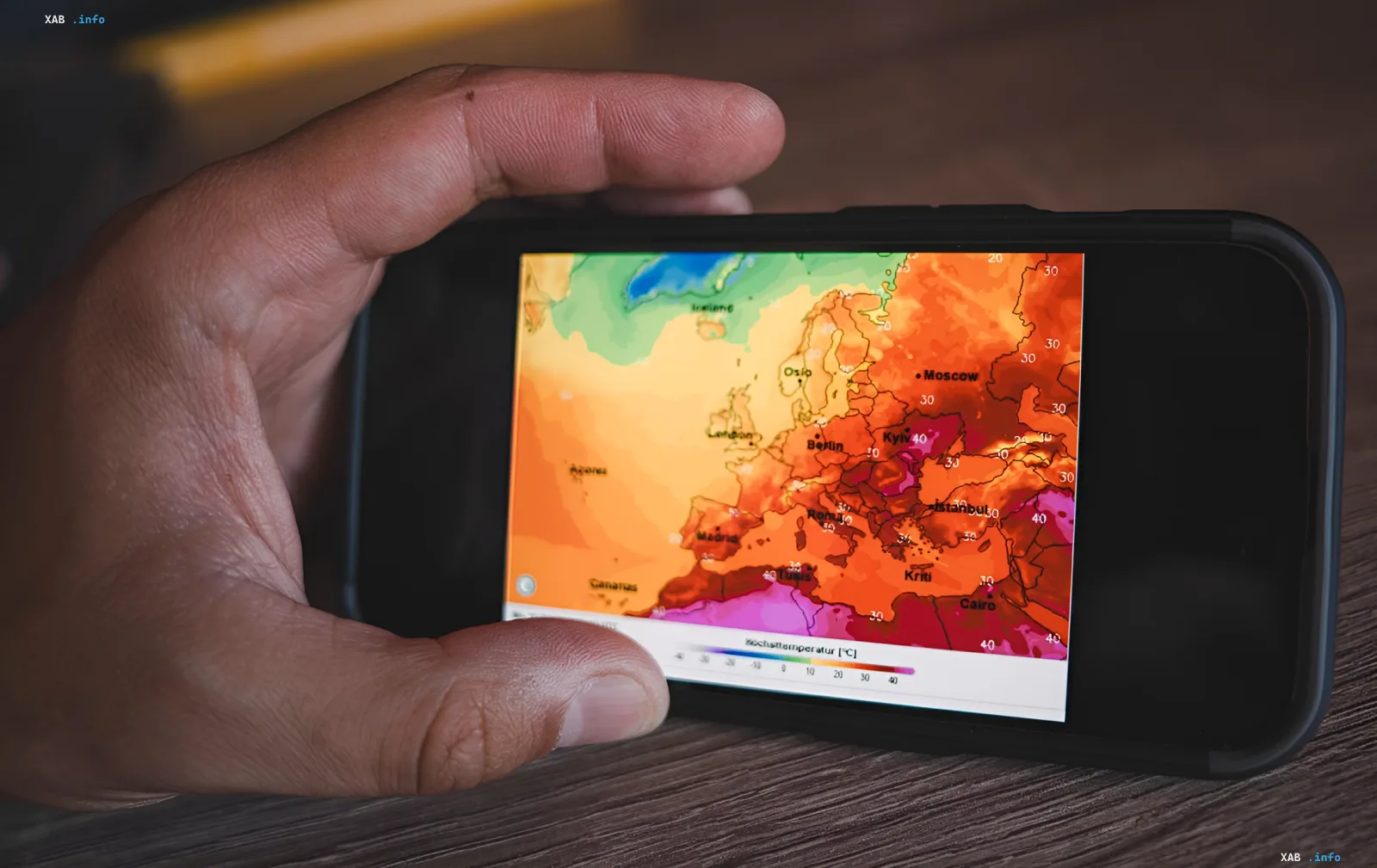
Summer 2026 has become one of the deadliest in Europe's recent history: four successive waves of anomalous heat, which have been sweeping across the continent since May, have led to at least 35,000 excess deaths, according to preliminary estimates. According to the combined data of national health agencies and meteorological services, the largest contribution to excess mortality came from three countries — Germany, France and Spain — where the combined number of "excess" deaths has already exceeded 25,000. At the same time, analysts emphasise that the final figures are not yet closed: as data for the second half of August is received and aggregated, the indicator is expected to rise significantly.
Chronology of the four waves and temperature records
The heat in Europe this year began unusually early — as early as spring, in May, when the first temperature records were registered on the western part of the continent. Since then, waves of heat have followed one after another, successively covering Western Europe. The most extreme values were recorded at the end of June: in Germany, the thermometer rose above 40 degrees at 46 meteorological stations, while in Spain temperatures remained above 42 degrees for an extended period. In France, the 40-degree threshold was exceeded at more than 500 weather stations. Climatologists link this sequence and intensity of extreme events to a rare "Omega" atmospheric block, which, according to reports, "trapped" hot air over the European territory.
Mortality by country: what national institutes are saying
According to an estimate by The Guardian, in Germany between 6 April and 9 August the heat may have been linked to around 14,000 deaths; the Robert Koch Institute separately reported that around 9,600 people died in the week from 22 to 28 June alone. The mortality monitoring system of the Carlos III Institute of Health in Spain linked 4,947 deaths to the heat — this already exceeds the previous national anti-record of 2022, when 4,520 people died from the heat. France's National Health Agency recorded 7,300 excess deaths from all causes between the end of May and 22 July. In the United Kingdom, the Medical Safety Agency estimated the number of heat-related deaths in England for May and June at 2,877 cases. Belgium reported a 39% rise in mortality between 18 and 29 June — roughly 1,222 excess deaths — while in the Netherlands at least 900 more people died than usual between 22 June and 5 July.
Why heat is almost never listed on a death certificate
It is important to understand the methodological complexity: high temperatures rarely appear as the immediate cause of death. Heat, as a rule, aggravates the course of pre-existing diseases — triggering heart attacks, strokes, kidney failure and exacerbations of cardiovascular pathologies. That is why countries use different methodologies: Spain and Germany, in particular, model indicators in real time, comparing air temperature data with mortality dynamics. Establishing the final cause of death takes weeks and even months, which is why many European states had not yet published complete data by the beginning of August. This means that all the figures cited are preliminary and conservatively understated.
Contradictory data
There is a discrepancy in the final estimates in open sources. Baseline data and a number of European agencies use the wording "at least 35,000" excess deaths, while the Ukrainian outlet RBC.ua reports in its headline of "nearly 40,000 lives". The difference is explained both by differences in the coverage of countries and periods, and by the fact that part of the August data has not yet been aggregated: as it arrives, the lower bound of the estimate shifts upward. In addition, some media outlets (for example, Korrespondent) cite weekly snapshots — "more than 1,300 deaths in a week" — which is not equivalent to the cumulative lethal estimate for the whole summer and may create a false impression of the scale. Finally, the methodologies for calculating excess mortality in different countries are not standardised, so a direct addition of national figures gives only an approximate, not exact, sum. Both versions — "from 35,000" and "around 40,000" — reflect the same order of magnitude but differ in the degree of data completeness.
Climatic context: a trend, not a coincidence
According to the World Health Organization, heat-related mortality in the European region has grown by more than 30% over the past 20 years. Scientists are unanimous that anthropogenic global warming is making extreme weather events more frequent and intense, and the number of deaths linked to high temperatures is expected to rise. Thus, the summer of 2026 is not an isolated anomaly but a continuation of a sustained trend that is turning heat into one of the main "invisible" factors of mortality in Europe.