Massive power outages, which have become a routine part of daily life in Ukraine, at first glance should have buried the very idea of owning an electric vehicle. However, practice has shown the opposite: there are visibly no fewer battery-powered cars on city streets, and owners have successfully adapted to the new conditions. As Ukrainian EV expert and Autogeek founder Yevhen Mudryi notes, the key survival factor for electric transport during blackouts is the owner's "certain flexibility." Many already have a so-called "Plan B"—charging the car in a neighboring district, at their workplace, or at night when the load on the power grid decreases. Furthermore, modern electric vehicles have learned to charge quickly, allowing owners to replenish their energy reserves even when power outage hours alternate with short periods of electricity availability.
Towing with Regeneration: A Controversial Yet Working Method
One of the simplest and most controversial charging methods is towing an electric vehicle with another car in Drive mode with the accelerator released. The control electronics perceive the situation as standard regeneration (coasting downhill, and the traction motor acts as a generator, feeding energy back into the battery). The main downside: EV manufacturers do not endorse this method and in some cases explicitly prohibit it. The risk is that standard regeneration is designed for short durations, and prolonged towing can cause the electronics to overheat. Nevertheless, real-world owners share positive experiences: a popular Nissan Leaf was charged from minimum to 73 km of range in ten minutes of towing; a Tesla replenished its battery from 0% to 9% over 6 km of towing; another case involved a Tesla gaining a charge from 14% to 55% over 40 km of towing, meaning the battery added 65 kWh of energy while the tow vehicle pulled the setup at speeds exceeding 110 km/h. On average, a standard electric vehicle gains about 1 kWh of energy for every kilometer towed. Experts recommend reviewing feedback from owners of specific models before applying this method.
Portable Power Stations: A Power Bank for Your Car
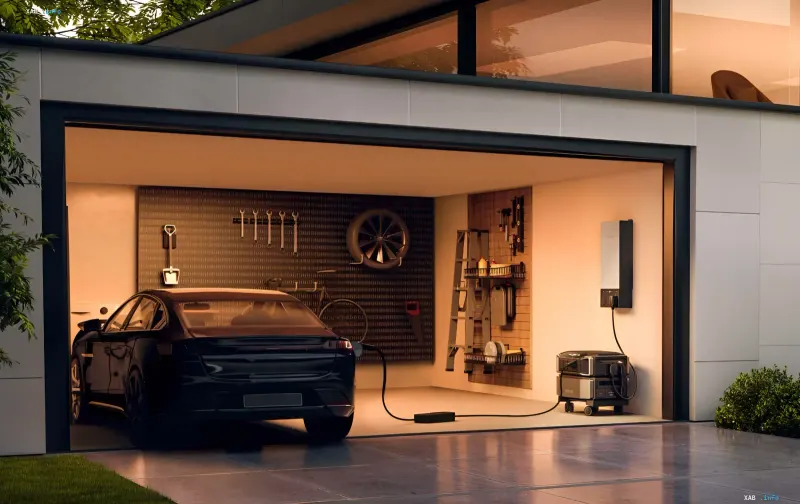
The second method, which raises no objections from either auto manufacturers or portable electronics makers, is connecting the electric vehicle to a portable power station (such as EcoFlow or Bluetti), which Ukrainian residents have been using en masse in apartments during blackouts. The car is connected via a standard Type 2 cable to the station's outlet and perceives it as a regular household electrical grid. Any electric vehicle supporting alternating current (AC) charging will work. However, there is an important nuance: the station must be sufficiently powerful and capacious—around 2,000–4,000 Wh, whereas most home power banks do not exceed 1,000 Wh. Even with a serious power station, it will not provide extensive driving range, but it is quite sufficient for a top-up of several dozen kilometers in a critical situation.
Solar Panels, Generators, and Home Batteries
The third and fourth charging methods involve alternative energy sources, which are particularly relevant for private house owners. Solar panels allow the car's battery to be replenished during daylight hours when the grid is down, while a generator provides stable power for charging at any time of day. A home battery acts as a buffer: it stores energy during hours when electricity is available or from a generator, and supplies it to the electric vehicle during a blackout. All these solutions require advance preparation and certain financial investments, but in practice, they often work and make the electric vehicle a truly autonomous mode of transport.
Eco-Driving as Part of the Strategy
An important accompanying factor emphasized by experts is the driving style itself. A mindful EV driver tries not to let the battery drop to absolute depletion, which is critical for executing unconventional energy replenishment methods. The higher the remaining charge, the easier and safer it is to apply any alternative method. Combined—flexibility in choosing charging location and time, having a "Plan B," fast-charging capabilities, and a sensible approach to battery consumption—these elements form a sustainable strategy for owning an electric vehicle amid regular blackouts, making battery transport not vulnerable, but rather more autonomous compared to fuel-powered vehicles.