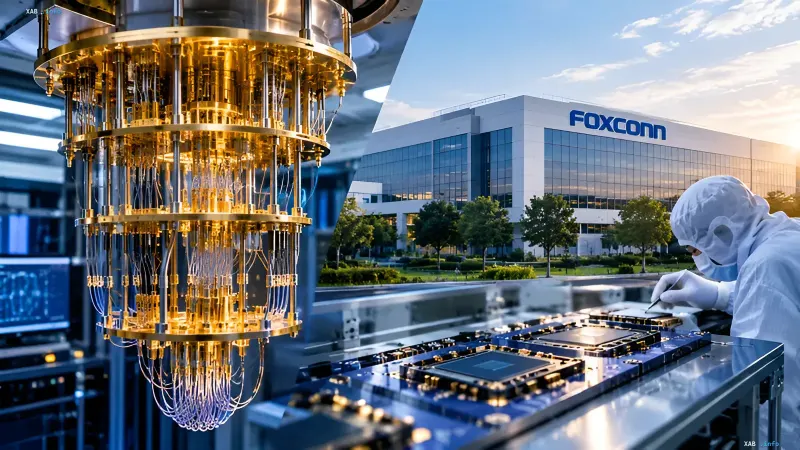
Foxconn Chairman Young Liu announced in a recent interview with CNBC the company's strategic goal: Foxconn aims to become the world's largest manufacturer of quantum computers by 2030. At the same time, according to Liu, achieving this goal does not require Foxconn to own its own quantum technologies. "We are focusing on manufacturing," the executive emphasized. By leveraging its quantum capabilities, the company expects to become the largest contract manufacturer of quantum computing systems, relying on years of experience in designing and mass-producing complex electronics. The model involves manufacturing quantum computers for companies that independently develop hardware quantum platforms.
Contract Model: From Smartphones to Qubits
Foxconn's strategy logically stems from its historical position as the world's largest contract electronics manufacturer. The company, which has spent decades assembling devices for Apple, Samsung, and other brands, intends to bring this approach into the quantum sphere. Foxconn will use its accumulated expertise in development, design, and serial production of high-precision electronics to assemble quantum systems designed by third-party companies. Meanwhile, as Liu clarified, the contract model does not exclude the parallel development of its own quantum technologies: Foxconn specialists are already experimenting with ion-qubit platforms. Thus, the company is laying a dual foundation — external manufacturing and internal R&D.
Commercialization: At Least Two Years and Million-Dollar Cables
Despite ambitious plans, Young Liu does not consider quantum computing a ready commercial market. By his estimate, at least two years remain before the practical commercialization of the industry. "I would say it will take at least another two years, and I think that applies not only to us. I think that applies to the entire industry," Liu stated. He cited the extremely high cost of specialized equipment as one of the key obstacles. As a clear example, Liu mentioned the cable used in quantum systems: the cost of each meter or even a short segment can exceed $1,000 due to strict operating conditions and temperature requirements. This clearly demonstrates how expensive even individual components of a quantum computer are, not to mention creating a full-fledged computing system.
Quantum Accelerators, Not CPU and GPU Replacements
Of particular note in the interview is Young Liu's stance on the place of quantum computers in modern computing system architecture. The Foxconn executive, having held numerous consultations with quantum hardware developers, describes quantum machines as specialized accelerators that will work alongside traditional central processing units (CPUs) and graphics processing units (GPUs) rather than replacing them. "I wouldn't say quantum computers will be the next revolutionary step in computing. It will be a new addition to existing computing devices — specialized systems that accelerate certain computations," Liu explained. We are talking about problems unmanageable for classical computers — so-called NP problems (nondeterministic polynomial time) — where quantum algorithms can potentially provide a significant, up to exponential, speedup. Among promising areas are molecular and materials simulation, optimization problems, and certain cryptographic tasks. At the same time, solutions obtained by the quantum accelerator can be quickly verified using classical methods, spending an acceptable amount of time and resources.
Outlook: Hybrid Servers by 2029
Summarizing the above, we can expect the first quantum platform accelerators integrated into server architecture to appear on the market by 2029. Foxconn sees itself at the forefront of their mass production process. As the range of tasks for hybrid quantum-classical systems expands and their practical effectiveness is confirmed, the industry may receive quantum computers with real commercial value in the foreseeable future. The success of Foxconn's strategy will depend on how quickly the industry overcomes component cost and temperature barriers, as well as the readiness of customers — quantum platform developers — to hand over production processes to a contract manufacturer.