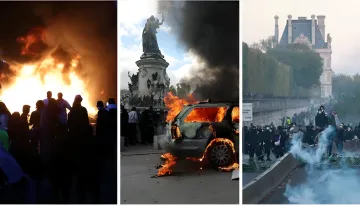
France is recovering from some of the most massive and violent street unrest in recent decades. The protests, which began last month from schools in the suburbs of Paris and targeted the rising cost of life, high energy prices, and problems in the educational sector, have escalated into a nationwide crisis. According to Interior Minister Laurent Nunez, 110 marches took place across the country, with authorities estimating participation at 550,000 people, while organizers put the figure at around 800,000. On Saturday, the situation completely spiraled out of control: peaceful demonstrators were joined by aggressive marginal groups and criminals, leading to looting, arson, and clashes with the police in dozens of cities.
From School Protests to Nationwide Crisis
According to Interior Minister Laurent Nunez, starting from noon—and in Marseille as early as the morning—"several thousand ultra-left individuals, intent on attacking public buildings and security forces, committed illegal acts." Subsequently, according to him, they were joined by criminals who looted and smashed numerous stores in Paris, Marseille, Lyon, Bordeaux, Rennes, Strasbourg, Grenoble, Nice, Limoges, and many other cities. At the rallies, alongside anti-government slogans, left-wing radical and "pro-Palestinian" symbols were prominent—to the extent that they were placed on the equestrian statue of Joan of Arc, and the statue itself was "dressed" in a makeshift hijab.
Paris and Other Cities: Arson, Looting, Clashes
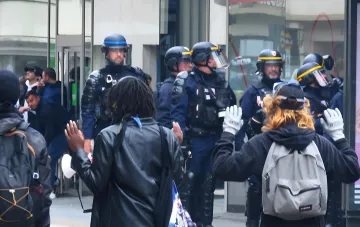
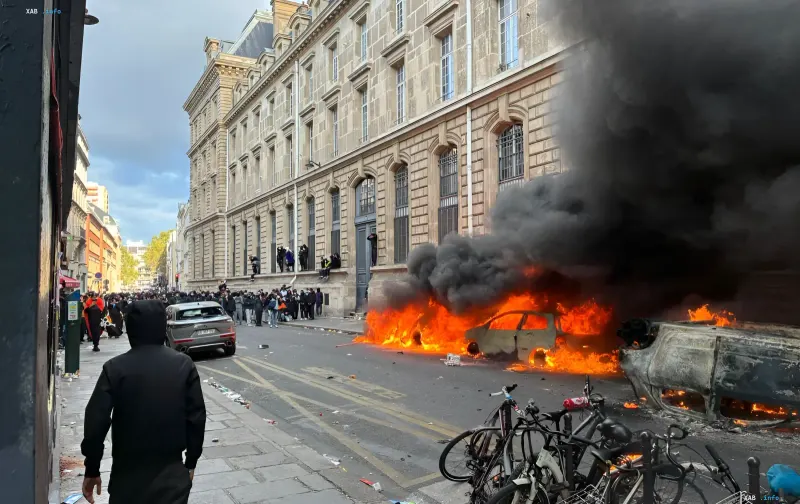
The most difficult situation unfolded in Paris, where groups ranging from several hundred to over 1,000 people staged unauthorized marches. Around the Place de la Republic, streets were littered with torn-up paving stones and broken glass; around 8:00 PM, young people tried to storm the Galeries Lafayette and then moved toward the Les Halles shopping district. Police used tear gas and water cannons against the crowd, which pelted law enforcement officers with fireworks, stones, and paving stones. In Limoges, protesters set fire to the town hall building, which was reportedly "largely destroyed" by the fire; acts of vandalism were also recorded in Lyon, Bordeaux, Rennes, Strasbourg, Grenoble, and Nice.
Casualties and Detainees
According to official Interior Ministry data, the number of detainees in France has risen to 2,000 people. During the clashes, over 600 police officers, gendarmes, and firefighters were injured; one fatality linked to health issues during the mass unrest was also recorded. According to Sky News, a teenager in Saint-Etienne lost a hand due to a grenade explosion—this is already the second such incident during the protests.
Economic Damage and Authorities' Response
President of the French Federation of Commerce and Distribution Alexandre Bompard estimates the number of directly affected retail outlets at 1,500, and total damage at hundreds of millions of euros. As BFMTV reports, President of the Paris Chamber of Commerce and Industry Gerard Barbier stated that a crisis headquarters would start working the next day to help entrepreneurs; he advised merchants to document damage with photos and videos for expert assessments, notify insurers, and file police reports. The Interior Minister stressed that "there is no place for violence in the Republic" and that the organizers of the riots "will be prosecuted and punished." President Emmanuel Macron held an emergency meeting with top government officials and delivered an address to the nation at 8:00 PM local time.
Pan-European Context
Against the backdrop of rising prices across Europe, smaller-scale actions were also recorded in other countries: in Italy, clashes with police and arson occurred in Milan; in Portugal, peaceful protests for housing rights were held in Lisbon; and similar sentiments were noted in Belgium. Thus, the French crisis has become part of a broader landscape of socio-economic discontent on the continent.