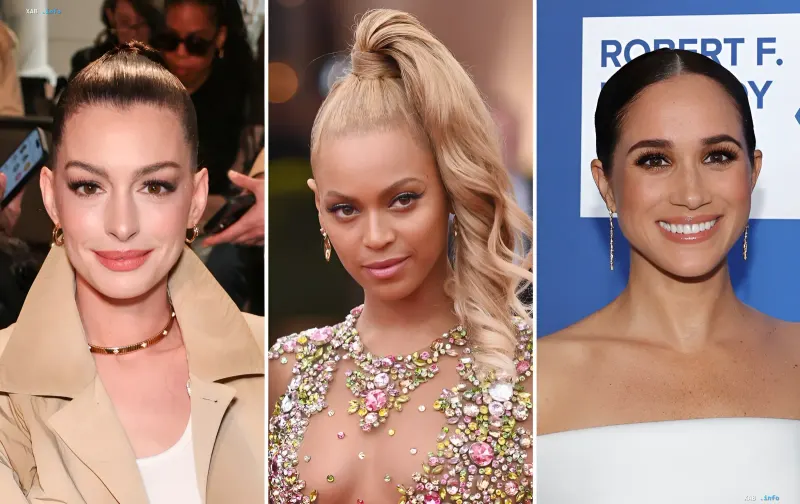
In the era of total visualization and social media, a celebrity's pregnancy has ceased to be just a joyful event. It has turned into an object of close, and sometimes paranoid, analysis. Internet users, armed with magnifying glasses and skepticism, often start looking for "proof" that a star's belly is just clever makeup or a prosthetic attachment. In August 2026, the list of stars who became victims of such theories added the name Anne Hathaway.
Anne Hathaway: "Wigs, Real Belly"
The freshest story in our selection happened in Los Angeles in August 2026. 43-year-old Anne Hathaway appeared at the premiere of the film "The End of Oak Street" in an outfit that fully revealed her pregnant belly. Photos of the actress instantly spread across the web, but instead of congratulations, a wave of suspicion followed. Some users began to speculate that the actress's belly might be fake: some didn't like its shape, others pointed out the navel, claiming it looked "unnatural".
Hathaway did not try to justify herself or argue with haters. She simply published a video of her preparation for the premiere and joked in the caption: "Wigs, real belly". Thus, the actress effectively put an end to the strange discussion, demonstrating that in 2026 stars prefer humor in response to absurd accusations.
Beyoncé and the Chair Incident: The Birth of a Myth
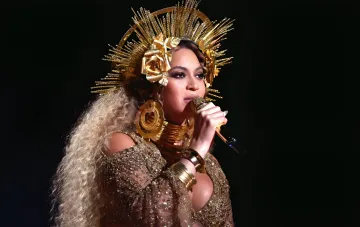
In 2011, pop diva Beyoncé went through a similar story. It concerns a situation that occurred during the Australian TV show "Sunday Night", where the singer sat in a chair, and the fabric of her dress unexpectedly changed shape in the belly area. This movement of the fabric, which was noticed in slow-motion video, became a catalyst for thousands of comments.
That was enough for the internet to erupt with assumptions: that the pregnancy was not real, and the singer was using a special fake belly. Videos were slowed down, paused on individual frames, and every movement was discussed. The theory became so popular that even major media outlets took notice. Beyoncé's representative called these rumors "nonsense" at the time, but the very fact that millions of people believed in the possibility of faking a pregnancy was shocking.
Meghan Markle and the "MoonBump" Phenomenon
During Meghan's pregnancy in 2019, internet theories received even more whimsical development. Social media spread the claim that the Duchess allegedly used a "MoonBump" — a fake belly used for film and television shoots. Supporters of the theory compared photos of Meghan from different angles, paying attention to how the shape of the belly changed while walking or sitting, and tried to find "inconsistencies" in sizes.
No credible evidence that Meghan simulated a pregnancy or used a fake belly ever appeared. But the theory itself grew so large that it became a separate phenomenon of internet culture, demonstrating how quickly rumors can turn into a global conspiracy theory.
Kim Kardashian and Katy Perry: From Surrogates to Latex
Kim Kardashian had to face similar accusations during her second pregnancy in 2015. Users compared her photos and wondered why the belly seemed big in some shots and smaller in others. From this arose the assumption that Kim allegedly wore a fake belly or was hiding the use of a surrogate mother. At first, Kardashian reacted to this with humor, but later she clearly got tired of the constant discussions. She even published a nude selfie showing her pregnant belly, effectively answering skeptics without extra words.
Katy Perry also did not escape close attention to her belly during her 2020 pregnancy. The singer announced her future motherhood in the "Never Worn White" music video, and then regularly showed her pregnant belly in public performances. Various assumptions also arose around the singer's appearance and belly shape on social media. However, there is no credible confirmation of the theory about any "latex prosthesis". In the end, in August 2020, Perry gave birth to a daughter — Daisy Dove Bloom.
The Psychology of "Internet Detectives"
All these stories have one common feature: one unusual photo became the reason for a whole conspiracy theory. A belly can look different depending on pose, clothing, angle, and lighting. But on social media, sometimes one unfortunate frame is enough for a "sensation" to be born instead of an ordinary photo. This phenomenon shows how easily public opinion can be manipulated and how little trust the audience has left for the visual images of celebrities.