
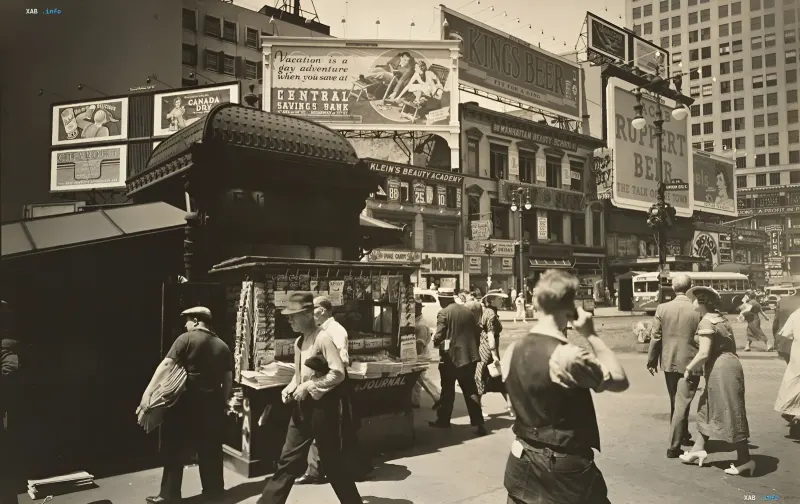
At first glance — a perfectly ordinary black-and-white shot of a New York street: Union Square in Brooklyn, 1936, "KINGS BEER", "RUPPERT BEER", "CANADA DRY" signs, a newspaper kiosk and a crowd of passers-by in hats. According to Styler, citing the Daily Express, it was precisely this photograph that triggered a new wave of conspiratorial discussion: in the frame, one of the men holds an object to his ear that looks strikingly like a modern mobile phone, and appears to be engaged in a lively conversation — five decades before portable mobile devices were officially invented. Styler breaks down the details at Styler.
The Union Square Snapshot: What Viewers Saw
According to conspiracy theorists, the detail in the foreground of the photograph is "irrefutable evidence" of time travel: a person in 1936 is supposedly using a device that should not appear until the end of the 20th century. Meanwhile, skeptics offer far more prosaic explanations for the same frame. With high probability, they note, the man could simply have been scratching his head, or holding a pocket watch or a hearing aid — devices that were already widespread in those years and, in shape, can indeed resemble a compact phone at a quick glance at an archival image.
1938 Film Footage and the Dupont Version
The discussion was further fueled by archival film footage from 1938: in the video, a group of people walks toward the camera, and one young woman is clearly talking, pressing a rectangular object tightly to her ear. The mystery, the material claims, was unexpectedly "solved" by a YouTube user going by the nickname Planetcheck, who stated that the woman on the film is his great-grandmother Gertrude Jones. According to him, the woman was 17 years old at the time of filming, and she worked at a factory of the industrial giant Dupont in the state of Massachusetts. The company, he claims, had a telecommunications department and tested wireless phones; Gertrude and five other women were allegedly issued these devices for one week of trials, and in the video she is talking to one of the scientists walking off-frame to the right.
A 1670 Painting and an 'iPhone' in the Hero's Hands
Another "stunning find," according to Styler, is hidden in the world of classical art. In a painting by the Dutch artist Pieter de Hooch, created in 1670, a cozy domestic scene is depicted, yet the attention of modern viewers was drawn to the man on the right: he holds an object in his hand that, in shape, size and the way it is held, looks like a modern iPhone. Art historians, however, assure that with the greatest probability it is an ordinary letter or a small book, and the striking visual resemblance to a gadget has made the canvas one of the favorite arguments of conspiracy theorists. Previously, Styler also reported a case in which a grandson noticed a "modern smartphone" in the hands of his soldier grandfather in an old photograph.
Contradictory Data
The main inconsistency in all three cases is the interpretation of the same visual record. Conspiracy theorists read in the frames and on the canvas direct evidence of time anomalies: a person from the past is supposedly using technology from the future. Skeptics and specialists (art historians, and in the case of the video — the "family" version of Planetcheck itself) offer alternatives: a head-scratching gesture, a pocket watch or a hearing aid in the 1936 photo; test wireless phones from Dupont in the 1938 film footage; and a letter or a booklet in the 1670 painting. It is important that the Dupont version relies on the statement of a single YouTube user about a family connection to the woman in question, which is not independent documentary confirmation; just as the "recognition" of a smartphone in old photographs is not supported by technical image analysis. Thus, both points of view coexist: one builds a narrative about time travel, the other — on mundane explanations, and neither side provides decisive, universally accepted proof.
Why Such Frames Keep Getting "Uncovered"
As the material notes, such finds regularly surface online and each time launch a new cycle of discussion: the viewer's brain tends to complete a familiar image when the outline of an object in an old image only vaguely resembles a modern gadget. This is exactly why archival photos, film footage and even 17th-century paintings become "favorite arguments" of conspiracy theorists, while the rational explanation — from a hearing aid to a letter in the hero's hand — is usually simpler and does not require postulating supernatural mechanisms. In the end, the Union Square "mystery," like the other two stories, remains in the zone of visual interpretation, not in the zone of confirmed fact.