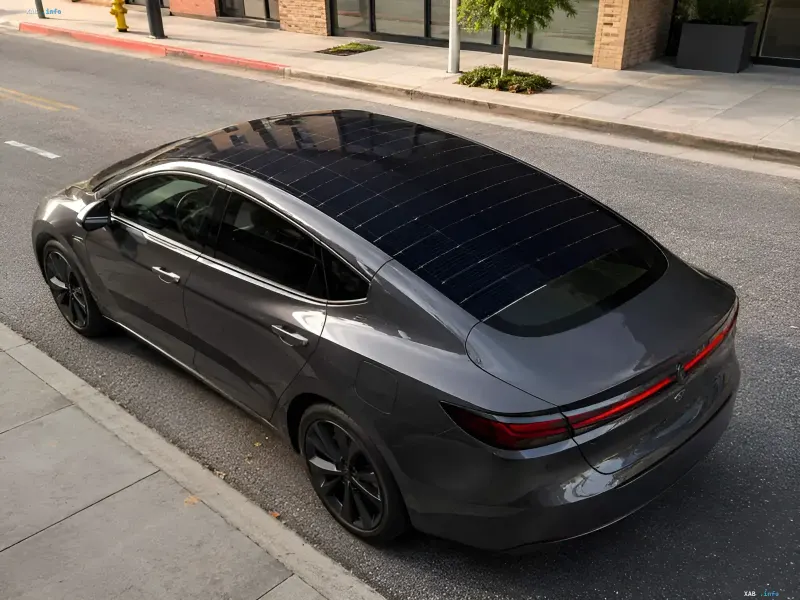
The world's largest manufacturer of automotive glass, China's Fuyao Group, has officially confirmed its readiness for mass production of panoramic roofs with integrated photovoltaic elements. The solar cells are integrated directly into the multi-layer laminated automotive glass and convert incoming light into electricity. As the company emphasizes, this output will not be enough to power the drive motors, but it will be more than sufficient for the air conditioning, cabin ventilation, and other auxiliary electronics.
From Laboratory Prototype to Serial Supply
The technology has already moved beyond the stage of a laboratory prototype. As early as May 2024, Fuyao told investors that it had made it possible to produce such glass in series and supply it upon customer request. Therefore, the current statement, made in 2026, rather indicates a transition to broader commercial deployment rather than a first announcement. According to the company, the photovoltaic modules are fixed inside the glass structure itself, and the voltage and current arising at the p–n junctions can be used by the vehicle's onboard electrical network.
Contradictory Data
Here the versions of the parties diverge. Chinese sources previously linked Fuyao's development to BYD and claimed that the solar roof could appear as an option for the Han and Tang models for around 8,000 yuan (about $1,190). The same sources cited a peak system output of 720 W, a photovoltaic cell efficiency of 23.18%, and the use of heterojunction silicon cells (HJT). However, these specifications cannot yet be considered officially confirmed: neither Fuyao nor BYD has published a joint technical description of the system. At an investor meeting, Fuyao also declined to disclose customers and the product price, citing commercial confidentiality. Thus, the core fact — readiness for serial production — is confirmed, while the specific figures, the link to BYD, and the price remain at the level of unconfirmed reports.
What a Solar Roof Will Actually Deliver
The roof area of a passenger car is too small for such a system to replace a full grid charge, but for the vehicle's auxiliary systems, the solar output from the roof may prove useful. While parked, it can power the cabin ventilation, onboard electronics, and other low-power systems, reducing the discharge of the main battery. This is especially relevant in hot climates, where keeping the cabin cool without a running engine is one of the main challenges.
Competitive Context and Prospects
The company is not alone in its effort to use the body surfaces of electric vehicles for solar generation. European manufacturers and individual enthusiasts around the world are pursuing the same goal. It is clear that this trend will develop: the appearance of an option such as "solar" sunroofs is quite likely. The retrofit will be available on many electric vehicle models and will not be particularly difficult, which makes the technology a potentially mass rather than niche solution.