

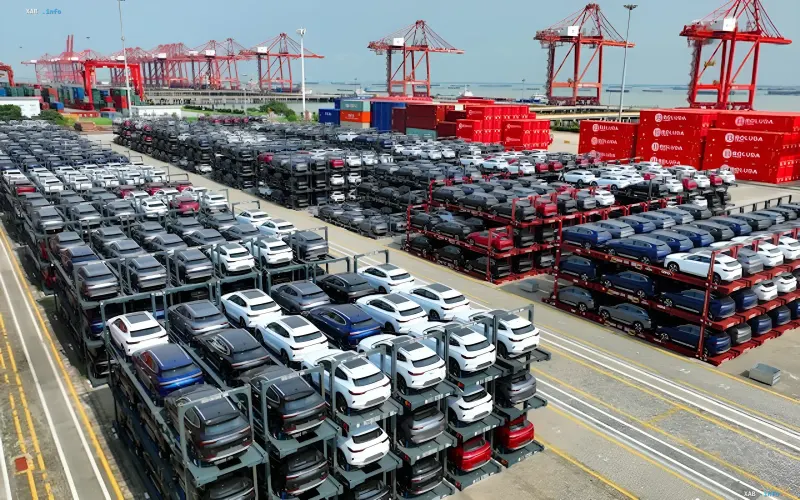
China's automotive industry in the second half of 2026 is exhibiting one of the sharpest imbalances in the global auto sector: export shipments are growing at record pace, while domestic demand stagnates. According to the China Passenger Car Association (CPCA), the volume of exported cars in July 2026 reached 923,000 units, up 88% year on year. At the same time, domestic sales in the same month amounted to just 1.47 million vehicles — 20% lower than a year earlier — marking the tenth consecutive month of decline. Analysts link this reversal to the exhaustion of domestic potential: companies such as BYD, Geely and Chery, which possess excess production capacity, are forced to redirect their output toward overseas markets.
Export boom amid a sluggish domestic market
At the macro level, the automotive sector reflects a broader problem of the world's second-largest economy, where supply systematically outstrips demand and production capacity far exceeds domestic consumption. As Reuters notes, for Beijing overseas markets are becoming not merely a sales channel but a condition for the industry's survival. In the first six months of 2026, domestic sales fell by 2.3 million units, or 20% in year-on-year terms — a volume comparable to the total number of new registrations on the Japanese market over half a year. Exports over the same period, by contrast, rose by 71%. Association chairman Cui Dongshu attributes the slump to domestic factors: rising fuel prices have hit demand for gasoline models, while the mass-market sedan segment is going through a prolonged downturn.
Pressure on Europe and Japan
On key external markets, Chinese brands are already creating noticeable competitive pressure. In Europe, in the first quarter of 2026, Japanese manufacturers held a stable 12% share of the passenger car market, virtually unchanged compared with the same period four years earlier. Over the same span, the share of Chinese automakers grew from 3% to 16%, and according to registration data this gain came at the expense of European, South Korean and American rivals. The gap is especially stark in the electric vehicle segment: Chinese brands account for nearly 25% of EVs supplied to Europe, whereas Japanese brands hold only about 5%. Abilash Gupta, an expert at Counterpoint Research, emphasizes that this is no longer just about price competition but about technological superiority. Counterpoint forecasts that by 2030 Chinese cars will capture more than 20% of the European market and 29% in the EV segment alone; tariff barriers, Gupta says, may slow the process but will not reverse it.
Contradictory data
When comparing sources, a discrepancy emerges in the absolute figures for July exports. The primary material, based on CPCA data, puts July 2026 exports at 923,000 units (+88% y/y). However, a number of Russian business publications, citing other aggregated indicators, report that monthly car exports from China in July 2026 exceeded the 1-million-unit mark for the first time. The difference is likely explained by differing counting methodologies: one figure includes only passenger cars, while the other covers the entire automotive flow, including commercial vehicles and data from foreign assembly plants operating within China. Both versions capture the same qualitative trend — record export growth — but the exact absolute value remains a matter of discrepancy at this point.
Forecasts and production localization
As for the outlook for domestic demand, HSBC financial expert Yuqian Ding notes that it has begun to stabilize and will likely recover from late August to early September, although a V-shaped rebound is not expected — the market will not see strong growth in the coming months. Strategically, Chinese manufacturers are not limiting themselves to exporting finished products: they are actively building their own plants in Europe, reducing dependence on tariff barriers. As Bill Russo, CEO of the consulting firm Automobility, summarizes, Chinese automakers possess enormous capacity, robust supply chains, improving products and substantial economic resources, and globalization has become a survival strategy for the country's largest players.