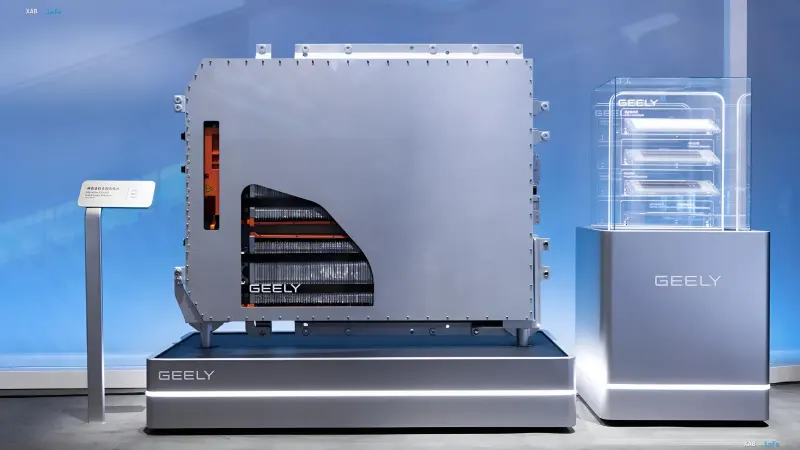
Geely Holding has announced plans to begin pilot deployment of solid-state battery packs in vehicles from its brands in 2027. According to the company, the most advanced version of the battery will deliver an energy density of up to 500 Wh/kg, which could potentially allow electric vehicles to travel more than 1,000 km on a single charge. As early as 2026, Geely has already begun testing the technology under real-world conditions, and after validation is completed in 2027, the batteries are planned to be installed in limited batches on vehicles from the holding's ecosystem — which includes Geely, Zeekr, Lynk & Co, Volvo, Polestar, Lotus, Smart, Proton, Farizon, and other brands. The company has not yet specified which exact models will be the first to receive the new batteries.
What This Means for Range
According to Geely's estimates, electric vehicles equipped with the new batteries will approach diesel-powered cars in terms of driving range. The stated target is more than 1,000 km on a single charge. The increased specific energy capacity theoretically makes such a range achievable without a proportional increase in battery mass, which is a key advantage of the solid-state architecture over conventional lithium-ion solutions.
Comparison with Current Golden Brick Cells
Geely is developing several variants of solid-state batteries with different specific energy capacities. The flagship version is rated at 500 Wh/kg. For comparison, the company's liquid-electrolyte Golden Brick cells have an energy density of about 250 Wh/kg at the cell level. Thus, the claimed gain is roughly twofold, confirming the scale of the technological leap that Geely intends to achieve within the next two years.
Partnership with Dow Chemical
One of Geely's partners in materials development is the American company Dow Chemical. The company previously developed a special adhesive for solid-state battery cells that maintains stability at temperatures ranging from -40 to +120 °C. This is critical for ensuring battery reliability across a wide range of operating climate conditions, from severe frosts to hot regions.
Realistic Mass-Production Timelines
That said, the mass appearance of fully solid-state batteries in electric vehicles in 2027 should not be expected. CATL previously rated its own technology at only the fourth level on a nine-point technology readiness scale (TRL), although the company expects to move on to full-scale prototypes and subsequent certification. In other words, 2027 will most likely be a stage of limited testing and pilot deployment, rather than full-scale mass production. BYD has also announced similar plans for 2027, indicating an industry-wide shift toward solid-state solutions.