Some video games masterfully disguise themselves as completely different projects: you launch a cozy simulator, a familiar card duel, or a space adventure without even suspecting that the developers have prepared something entirely different. In the process, familiar rules stop working, characters begin to behave unexpectedly, and the player themselves becomes part of the master plan. Styler editor Yulia Shikanova has gathered a selection of five games that intentionally mislead the player and force a rethinking of the playthrough format itself.
Stanley and the Narrator: Freedom vs. Script
The Stanley Parable begins as the story of an ordinary office worker named Stanley, who arrives at work to find that all his colleagues have vanished. It would seem to be a routine exploration of an empty office, but there is a catch: every action of the player is commented on by a narrator who "knows" in advance where Stanley will go, which door he will open, and what he will do next. The problem is that the player can simply choose not to follow his instructions—choose another door or go in the opposite direction. Then the narrator begins to react to the disobedience with irritation, humor, or entirely unexpected turns. The game is built around the conflict between the script and freedom of choice: here you can find alternative endings, return to familiar places, and discover new story developments, while trying to trick the game itself might turn out to be part of the plot. Special attention goes to the expanded re-release, The Stanley Parable: Ultra Deluxe, announced by studios Galactic Café and Crows Crows Crows at The Game Awards 2018 and released in 2019, which added new endings and content.
Inscryption: The Card Table as a Veil
Inscryption at first glance looks like a dark game about card duels: you sit in a mysterious cabin opposite a strange opponent, playing cards with animal imagery and trying to figure out the rules to win the match. But very quickly it becomes clear that the card table is just a part of a much larger puzzle. Inside the cabin, you can find items, interact with the environment, and solve riddles that affect the playthrough. The game constantly shifts expectations of what a game should be: it experiments with genres, mechanics, and narrative structure, so familiar rules should not be taken as final. Most importantly, Inscryption does not limit itself to surprises within individual matches—it forces a reassessment of the playthrough format itself, and what initially seemed like the main mechanic gradually reveals itself from another perspective.
There Is No Game: The Game That Refuses to Be a Game
There Is No Game: Wrong Dimension begins with the program categorically refusing to consider itself a game. Instead of a standard menu, the player is greeted by a voice demanding not to click anything, not to interact with screen elements, and to leave the program alone entirely. Naturally, the player does the exact opposite—and thus begins a comedic adventure where you must interact with the interface, drag elements, look for hidden clues, and use items completely out of context. The game constantly breaks the fourth wall: it comments on actions, argues with the player, and tries to hinder progress, while solving certain puzzles literally requires stopping to perceive the screen as a normal gaming space. Buttons, menus, and other interface elements become part of the event, and interacting with the game itself turns into a source of humor and surprises.
Undertale: An RPG Without Mandatory Combat
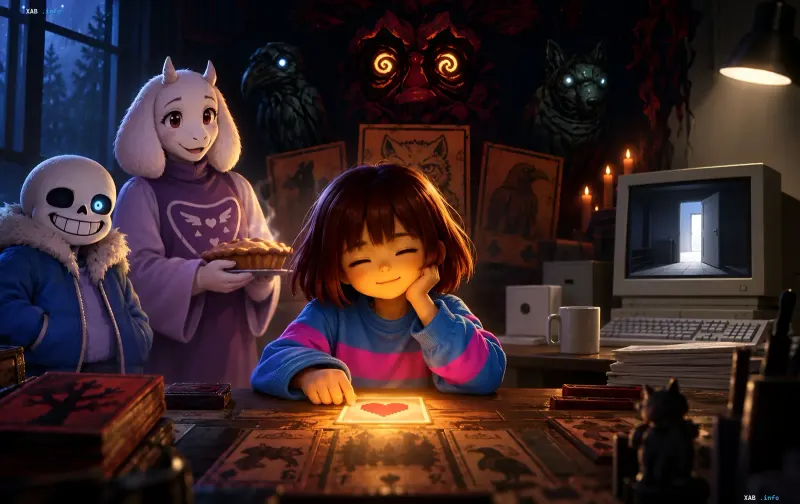
Most role-playing games train players in simple logic: encounter an enemy, enter combat, win, receive a reward. Undertale tests whether the player is ready to abandon this habit. The action takes place in an underground world inhabited by strange creatures, and while you can fight them, combat is far from the only way to interact: you can make one enemy laugh, calm down another, or simply talk to some. Choice matters: the story's development, the characters' attitudes, and the final outcome all depend on the player's behavior. The game makes you wonder why we are used to resolving every conflict with force and whether victory always truly means victory. Undertale subverts expectations not through a single plot twist, but through its entire approach to the genre, showing that an RPG can be about more than battles, levels, and rewards—it can also be about responsibility for one's own decisions.
Outer Wilds: A Space Adventure with a Catch
Concluding the selection is Outer Wilds, which initially resembles a standard space adventure: the player becomes an explorer, gets a spaceship, and sets out to study a small star system with several unusual planets. On the surface, everything looks like a classic formula—gathering resources, upgrading equipment, and gradually unlocking new locations. However, just like the other projects in the selection, behind the familiar facade lies a design that breaks expectations and makes you look at the exploratory space adventure genre from an unexpected angle.
The common thread among all five games is the deliberate subversion of genre expectations. Developers use familiar formats as a veil hiding completely different mechanics, narratives, or gameplay philosophies. That is why these projects are remembered not as "just another game in the genre," but as an experience that reshapes the player's own habits.