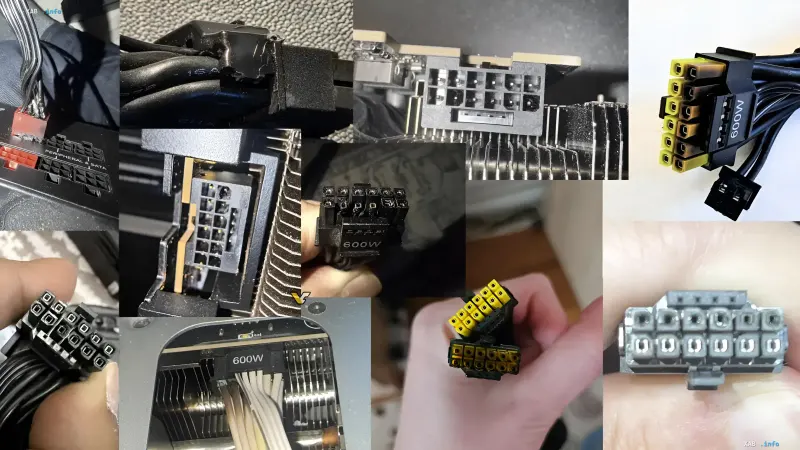
The issue of overheating and melting 16-pin power connectors on Nvidia accelerators, which has been reported since the launch of the GeForce RTX 50 generation, shows no sign of subsiding and remains widespread. According to VideoCardz, users reported more than ten new cases of cable, adapter, and connector damage in just the first two weeks of November 2026. A compilation of incidents gathered from Reddit, Chinese forums, and other specialized communities shows that this is not an isolated manufacturing defect, but a recurring type of failure affecting various models and different elements of the power supply chain.
Not Just Flagships Affected
Previously, melting statistics were largely associated with the top-tier GeForce RTX 5090, but the fresh compilation features a noticeably broader range of models: GeForce RTX 5090 D, RTX 4090, RTX 5080, RTX 5070 Ti, and RTX 5070. In some instances, contacts directly on the graphics card PCB melted, while in others, bundled adapters or power supply cables were damaged. VideoCardz specifically highlights a case involving a damaged modular connector on a Thermaltake power supply used alongside an RTX 5070 Ti, indicating that degradation can affect not only the accelerator side but external power sources as well.
RTX 5070 in Statistics: An Anomaly Against Low Power Consumption
Reports regarding the GeForce RTX 5070 are particularly notable. Nvidia specifies a power consumption of 250 W for this model—more than twice as low as the RTX 5090 with its 575 W. Nevertheless, RTX 5070 owners have also discovered melted adapters and damaged contacts. One user reported black screens and unexpected computer reboots prior to discovering the failure. Another owner of an Asus Dual RTX 5070 model received a refund from the retailer because a replacement could not be provided. The presence of a moderate power consumption model in the statistics complicates explaining the incidents solely by overcurrent.
Possible Causes and Limits of Diagnostics
Communities cite potential causes for such incidents as a plug not being fully inserted into the connector, poor electrical contact, and uneven current distribution among the pins. However, determining the exact cause of each individual case from user-published photographs is impossible: visual signs of melting can be either the consequence of overload or the result of a mechanical or contact defect. VideoCardz also emphasizes that it remains unknown how many similar incidents go unnoticed or fail to enter public discussions, meaning the real number of cases is likely higher than recorded in the compilation.
Context: The Problem Has Been Ongoing Since Summer
The reminder that incidents involving the GeForce RTX 5090 and melting power supplies were recorded as early as June 2026 demonstrates that the problem has not been resolved at the mass-market level over the course of several months. For users, this means that when operating RTX 50 generation accelerators, attention should be paid to the quality of the 16-pin connector installation, the condition of adapters, and power supply compatibility, as well as monitoring early signs of overheating—instability and reboots—which in some cases preceded visible contact damage.