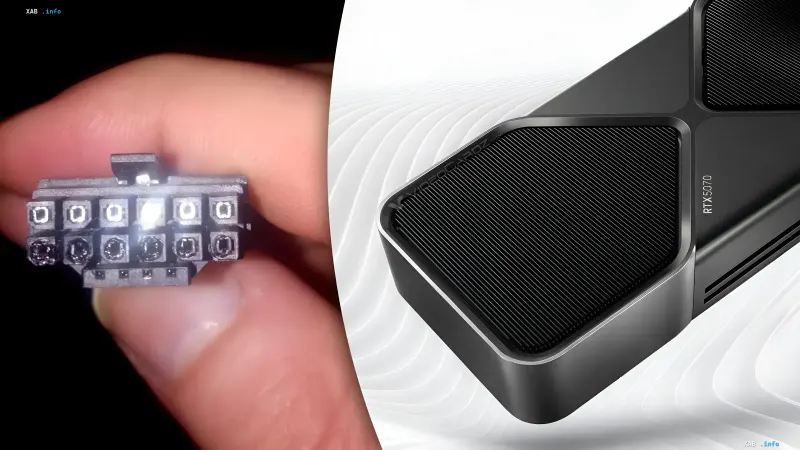
Nvidia GeForce RTX 50-series graphics card owners continue to report issues with power connectors, and this time, the focus is not on the flagship RTX 5090 or RTX 5080, but the GeForce RTX 5070 with a power draw of just 250W. Reddit user Gatlyng posted photos of a melted 12V-2×6 connector on their card, fueling a new wave of discussion regarding the reliability of the new power connection standard in graphics accelerators. Notably, the incident occurred on a model with power consumption nearly 2.3 times lower than the flagship RTX 5090 (575W), making the case particularly alarming.
Owner's version: loose contact as a probable cause
In their Reddit post, Gatlyng admits that the damage could have been caused by an installation error. According to the user, a friend installed the card and might not have fully inserted the power cable into the connector. A loose connection, as is well known, increases electrical resistance at the contact point, leading to localized overheating. This results in the melting of the plastic connector housing and damage to the metal pins. The published images show deformed and melted elements of the connector, visually confirming the mechanism of thermal destruction.
Not the first case: the Zotac RTX 5070 and Seasonic Focus GX-750 story
It is worth noting that this is far from the first such incident with the GeForce RTX 5070. Back in April 2025, a report appeared online regarding a Zotac RTX 5070 connected to a Seasonic Focus GX-750 power supply. After the computer was turned on, the power cable began to melt, and photos revealed one of the pins appeared to have shifted inside the connector. The exact cause of that incident could not be determined—neither the card manufacturer nor Nvidia issued an official comment. The coincidence of the model and the type of damage in both cases points to a systemic issue rather than a one-off defect.
The 12V-2×6 standard problem: why low power draw is no guarantee of safety
The 12V-2×6 connector, introduced by Nvidia in the RTX 50 series, initially caused concerns among enthusiasts and hardware experts. Its design, where 16 pins are combined into a compact block, creates a risk of incomplete cable seating during connection. Unlike traditional 8-pin PCIe connectors that simply prevent the system from booting if improperly installed, the 12V-2×6 can be connected "halfway," and the system will still operate—but with increased resistance at the contacts. For high-TDP models like the RTX 5090, this leads to catastrophic consequences. However, the RTX 5070 case shows that even at a moderate load of 250W, a loose connection can cause localized overheating sufficient to destroy the plastic.
Who is responsible: manufacturer, user, or the standard?
In this new case, circumstances do not allow for assigning blame exclusively to Nvidia or a specific graphics card manufacturer. An incompletely inserted cable is, in essence, a user error, and no manufacturer can guarantee protection against such scenarios. Nevertheless, the collection of incidents—from RTX 5090 and 5080 to RTX 5070—forms a consistent pattern: the 12V-2×6 standard in its current iteration remains vulnerable to installation errors. The lack of a mechanical latch preventing the cable from being connected "halfway" and insufficient visual indicators for correct seating make the connector potentially dangerous even for experienced users. Until Nvidia presents a revised revision of the connector or additional installation guidelines, owners of 50-series cards should pay special attention to the quality of their power cable connection.