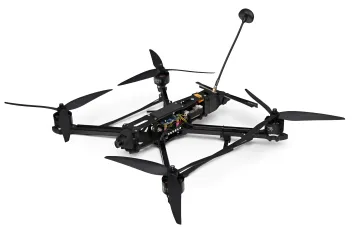
On Kyiv's bridges, according to Novaya Gazeta Europe, there are turrets that independently detect 'Geran' suicide drones, calculate their trajectories, and aim machine guns at the target — a human only needs to press a button. The publication notes that the next step in this logic is to remove the button altogether: an Ukrainian drone manufacturer reportedly claims that such a test has already been conducted. Weapons that choose whom to destroy themselves are professionally referred to as 'Lethal Autonomous Weapons Systems' (LAWS), but UN Secretary-General António Guterres suggests calling a spade a spade — 'killer robots.' It is around this term and its legal status that the Seventh Review Conference of the Convention on 'Inhumane' Weapons will open on November 16 at the Palace of Nations in Geneva.
Three scenarios for 128 states
Over five days, 128 countries party to the Convention on Prohibitions or Restrictions on the Use of Certain Conventional Weapons Which May Be Deemed to Be Excessively Injurious or to Have Indiscriminate Effects will have to choose one of three options. The first is to issue a mandate for negotiations on a legally binding document. The second is to settle for a political declaration without obligations. The third is to extend the discussion mandate of the Group of Governmental Experts for another term. The pressure on delegates is set in advance: three years ago, Guterres and ICRC President Mirjana Spoljaric called for a treaty on these systems 'by 2026.' The year is ending, and there is still no treaty.
Consensus as a brake: why 12 years haven't yielded even a definition
Geneva discussions on 'killer robots' have been ongoing since May 2014, when the first UN meeting of experts on LAWS was held. In 2016, an open-ended Group of Governmental Experts was created for them, and in 2021, the review conference agreed only to 'consider proposals and elaborate by consensus possible measures.' The Stop Killer Robots coalition called this result one that does not reflect 'the will of the overwhelming majority of states.' The root of the problem is in the procedure: decisions at review conferences are made by consensus, and one country's objection is enough to stop the whole process. The clarity of this logic was demonstrated by last year's Annual Meeting of High Contracting Parties: the allotted three days were squeezed into 31 minutes — delegates skipped general debates and moved directly to procedural issues.
Who wants what: a compromise mandate against the US plan
The draft mandate to be discussed by the conference's committee proposes that the expert group 'negotiate a new protocol to the convention' — the sixth one — for 15 days a year and submit its draft in 2028. This is already a compromise: in October, Austria, Belgium, Brazil, Ireland, Mexico, New Zealand, and Panama suggested finishing in 25 days and one year — 2027. Yet even the compromise text preserves the main rule: the group conducts its work and adopts reports by consensus, and the veto power remains even at the negotiation stage. Washington has its own plan: in a working document dated November 4, the US proposes giving the group another five years, until the next review conference in 2031, and instead of a protocol, preparing a non-binding document — version 1.0 by 2029, and then versions 1.1 and 1.2.
The scales tip toward negotiations
According to Human Rights Watch, the cautious American logic has fewer and fewer supporters: 76 states, including 70 parties to the convention, already support a negotiation mandate — that is, a majority. For supporters of the treaty, the 1995 Protocol on Blinding Laser Weapons serves as an important precedent — this is the first time since 1868 that a weapon has been banned before its use on the battlefield (a century and a half ago, it concerned explosive bullets). The Convention itself, adopted in 1980 and entered into force in 1983, prohibits almost nothing directly: bans live in five protocols — on non-detectable fragments, mines and booby traps, incendiary weapons, blinding lasers, and explosive remnants of war. The key principle underpinning all arguments is the need to distinguish between civilians and military personnel and the prohibition of weapons that cause 'superfluous injury.' The outcome of the five-day Geneva session will show whether it is finally possible to turn 12 years of discussions into a subject for voting.