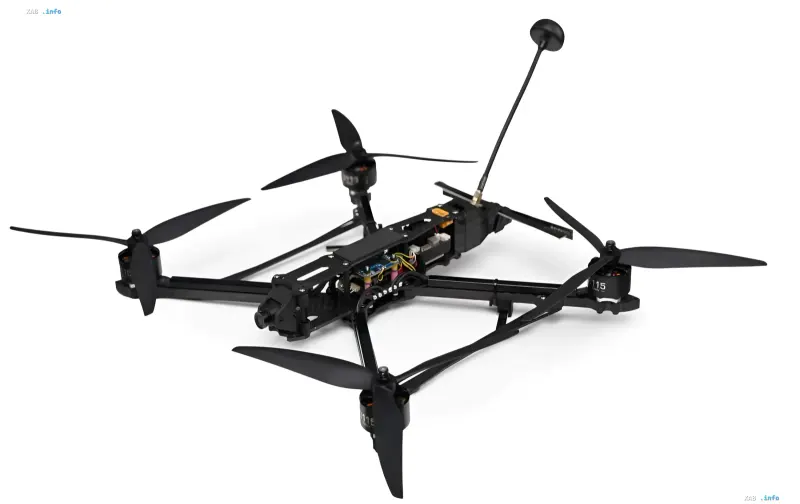
TAF Industries has launched an updated version of the Kolibri 10” Advance strike drone, equipped with the AURA AI detection and auto-guidance module developed by DOD Solution. According to the manufacturer, the solution increases the FPV drone's autonomy through artificial intelligence algorithms: the system itself detects, recognizes, and locks onto the target, while the operator merely confirms the attack, after which the module continues tracking the object and independently executes its destruction.
How the AURA AI Module Works
At the core of the solution is a custom single-board onboard computer developed by DOD Solution, optimized for running AI algorithms directly on FPV drones. Physically, it is an additional board stacked on the vehicle. The module provides detection, recognition, and tracking of both moving and static targets. A key feature of the system is its resilience to control channel degradation: according to TAF Industries, the Kolibri 10” Advance with AURA AI is capable of performing combat missions even under conditions of GPS signal loss, active electronic warfare (EW) countermeasures, and limited or completely absent communications.
Reducing Cognitive Load on the Pilot
TAF Industries emphasizes that the AI module primarily helps the pilot see all potential threats and targets by outlining them in a rectangle—essentially highlighting targets the operator might have missed. An additional advantage cited by the company is the recognition of various vehicle classes, which relieves the pilot of excessive cognitive load. Thus, the human remains in the decision-making loop, while routine search and target-holding operations are handled by the algorithm.
Frontline Deployment and Integration Timeline
According to information provided to RBC-Ukraine, the Kolibri 10” Advance with the AURA AI module has already been deployed by units of the 93rd Separate Mechanized Brigade "Kholodnyi Yar" and the 3rd Separate Assault Brigade. TAF Industries representatives also stated that technical integration of AURA AI into the new platform typically takes about one to two weeks, although within the framework of cooperation with TAF Industries, the process was more protracted as joint work covered not only direct module installation but also other stages of solution preparation and testing.
Broader Context: AI as a Systemic Element of Warfare
The release of the Kolibri with AURA AI fits into a broader trend. According to the press service of the Ukrainian Ministry of Defense, UAF units use over 70 artificial intelligence and machine vision systems for unmanned operations, and more than 200 companies in the country are developing AI drones; the Brave 1 Market defense tech marketplace offers the military 46 AI developments, including target recognition, optical stabilization, and auto-guidance systems. The Ministry of Defense has set a goal to equip 100% of frontline drones with machine vision and AI, while emphasizing that the final decision on target selection and engagement remains with a human. Experts, including those in reports by Al Jazeera and Financial Times, describe such solutions as part of a reconnaissance-strike architecture, noting that the war in Ukraine has become a major proving ground for military artificial intelligence, accelerating attacks and helping overcome electronic warfare, albeit with inherent risks associated with autonomous systems.
Notably, against the backdrop of these developments, an American manufacturer announced for the first time the production of Magura maritime drones, developed and tested during the war in Ukraine, while the Ukrainian strike drone "Liutyi" was converted into a missile carrier and debuted at an international exhibition in England.