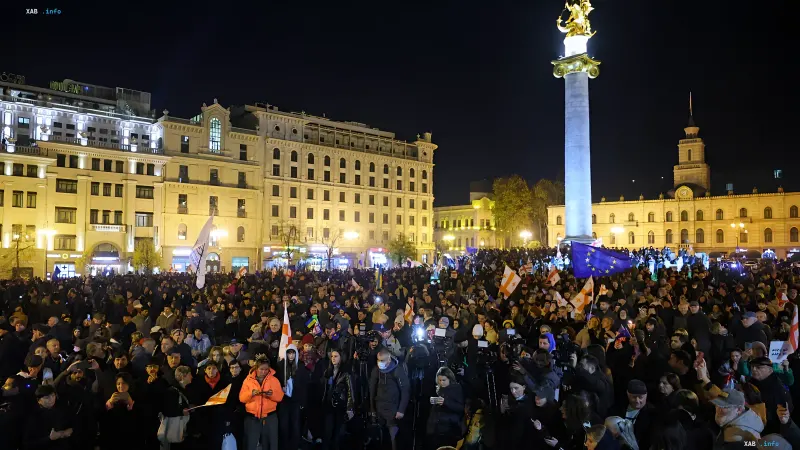
On Saturday evening, Tbilisi's central square once again turned into a sea of Georgian and European Union flags: according to organizers, tens of thousands of people took to the square, responding to the call of pro-European activists and five opposition parties currently facing a complete ban in the country. The demonstration marked the second anniversary of the freeze on Georgia's EU accession negotiations and became part of daily protests in the center of the capital, which participants say have not stopped for over two years. Protesters accuse the ruling Georgian Dream party of betraying the constitutionally enshrined European course, which, according to opinion polls, is supported by about 80% of the country's citizens.
Two Years of Continuous Protests
According to the organizers, the political crisis in Georgia originates in the fall of 2024. Following the parliamentary elections in October, which saw Georgian Dream consolidate control over power, Prime Minister Irakli Kobakhidze announced in November the suspension of the EU accession process until at least 2028. This decision triggered nationwide protests, which participants say were accompanied by police crackdowns. Despite the adoption of increasingly strict laws, heavy fines, and mass arrests, demonstrators continue to demand early elections and the release of all detained allies.
Pressure on the Opposition and Civil Society
According to the human rights organization Amnesty International, thousands of people have been subjected to arbitrary detention over the past two years, hundreds have reported torture and ill-treatment, and more than 150 individuals have been sentenced to prison terms. Ahead of the anniversary, authorities pardoned seven imprisoned protesters, while the Prime Minister emphasized that only those who admit guilt and express remorse can expect release. The situation is further complicated by growing pressure on the opposition: last month, the Constitutional Court of Georgia began reviewing a lawsuit by the ruling party to ban five leading opposition forces accused of attempting to overthrow the constitutional order — a ruling in this case is expected by June 2027.
Tbilisi and Brussels in a Deep Stalemate
Against this backdrop, relations between Tbilisi and Brussels remain in a deep stalemate. Although Georgia was granted candidate status in December 2023, European officials, including EU Enlargement Commissioner Marta Kos, now refer to it as a candidate "only on paper," pointing to democratic regression and the adoption of foreign influence laws. The European Parliament, in turn, warns that a potential party ban will further widen the gap between Tbilisi and the bloc.
The Government's Position
In turn, the Georgian leadership rejects accusations of abandoning European integration. Ahead of Saturday's march, Irakli Kobakhidze stated that the government still aims for full EU membership and is ready to sign documents starting negotiations any day Brussels agrees to open them, but strictly on its own terms. The authorities accuse the European Commission of double standards and imposing a liberal agenda, while blaming the opposition and former President Salome Zourabichvili for attempting to overthrow the government through street protests, arguing that Georgian Dream's policy aims to protect sovereignty and traditional family values from external interference.