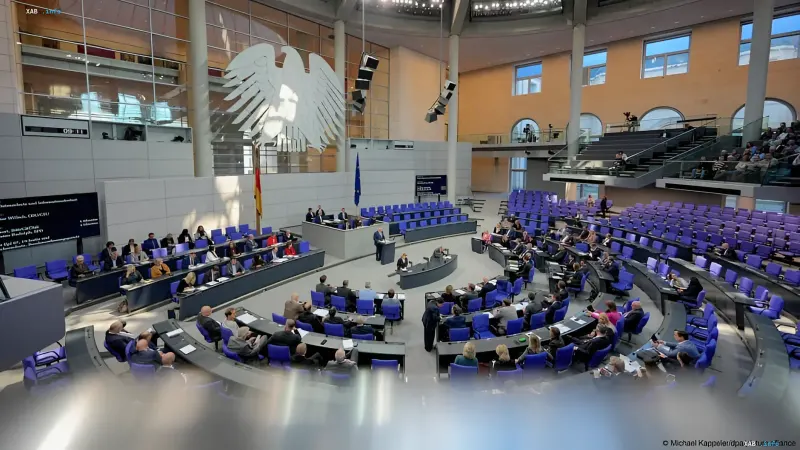
On Friday, November 27, the German Bundestag passed the federal budget for 2027 by a majority vote of the ruling coalition. A total of 317 lawmakers voted in favor of the bill, while 260 voted against, parliamentary leadership announced. The document provides for expenditures of €555.9 billion, which is roughly six percent higher than in the current year. Investments within the core budget will rise to €61.8 billion, and net new borrowing in the core budget will increase from €98 billion to €123 billion. Including two special funds—for infrastructure and the Bundeswehr—total new borrowing will exceed €210 billion, a figure surpassed only in the pandemic year of 2021, when new debt reached €215.4 billion.
Record Defense Spending and Support for Ukraine
Along with labor and social affairs, which account for over a third of core budget expenditures, defense is becoming a key priority. Spending on the armed forces is set to rise to nearly €140 billion—the highest level since the end of the Cold War. Support for Ukraine is explicitly designated as a separate line item: €12.2 billion is allocated for 2027. Thus, the budgetary maneuver links Germany's military strengthening with the continuation of financial and material assistance to Kyiv amid the ongoing conflict.
Borrowing at Pandemic-Era Highs
The German Ministry of Finance emphasizes that total new borrowing, including special funds, will exceed €210 billion. According to the ministry's estimates, Germany has only borrowed more in 2021, at the height of the coronavirus pandemic, when new debt reached €215.4 billion. This means that even in the "peaceful" year of 2027, public debt will grow at a pace comparable to the emergency measures of the pandemic period, driven simultaneously by the investment cycle and defense expenditures.
Social Measures, Taxes, and the "Sugar Tax"
Alongside the budget, the Bundestag approved the accompanying measures act for 2027. Under this legislation, the electricity tax for all consumers will be reduced to the minimum level permitted by the EU. Basic welfare benefits will be frozen until mid-2028, and state transfers to pension insurance will be cut by €3 billion in 2027. Taxes on high-proof alcohol will rise from the beginning of 2027, and a tax on beverages containing at least 5g of sugar per 100ml will be introduced on January 1, 2028. Finance Minister Lars Klingbeil urged the swift adoption of an agreed income tax reform that will reduce the burden primarily for low- and middle-income earners and families by a total of around €10 billion.
Negotiations on the 2028 Budget and Coalition Positions
During the final debates, Klingbeil warned the public of upcoming difficulties, stating that preparing the 2028 budget will be even harder than working on the 2027 document. "We will not be able to avoid asking people to make certain sacrifices," the SPD leader declared, emphasizing the need for a fair distribution of the burden. According to Ministry of Finance estimates, the deficit in the 2028 plans is around €25 billion, and if the electricity tax reduction is extended beyond 2027, it could rise to roughly €30 billion. SPD budget expert Thorsten Rudolf called for cutting subsidies and tax breaks by €10 billion—primarily environmentally harmful ones—referencing Chancellor Friedrich Merz's remarks about abandoning "cherished notions." Meanwhile, the CDU/CSU union intends to tie the adoption of the tax reform to the implementation of agreed labor market reforms, promising difficult intra-coalition negotiations.