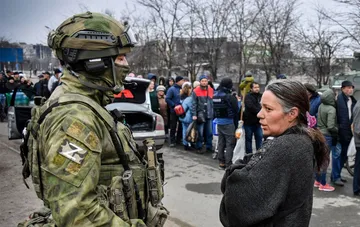
The German Federal Government has published its annual report on global religious freedom, documenting systemic restrictions on religious rights in territories of Ukraine occupied by Russia. Released on November 18, the document covers the period from 2023 to 2025 and explicitly indicates that Russian military operations are directed, among other things, against churches and believers. According to Berlin's assessment, the free practice of religion is 'not guaranteed' in areas controlled by Moscow, while numerous religious sites in the free part of the country have been damaged or destroyed as a result of Russian attacks.
Restrictions in Occupied Territories
The authors of the report emphasize that in the occupied territories of Ukraine, churchgoers belonging to denominations other than the Russian Orthodox Church can practice their faith only in private. Public worship and religious activities are effectively inaccessible to them, which, in the view of the German Foreign Ministry, constitutes a serious violation of freedom of conscience and belief. The document frames this as part of a broader policy to restrict religious life in the captured territories.
Repression Against Muslims and Crimean Tatars
Special attention in the report is paid to the situation of Muslims, primarily Crimean Tatars. It points out that Russian authorities subject them to particularly harsh repressions, formally justifying them under the guise of counter-terrorism. Furthermore, the document notes that, according to credible reports, Russian armed forces have killed, abducted, tortured, or imprisoned priests, pastors, imams, and monks of various denominations.
Destruction of Religious Sites
During Russia's military aggression against Ukraine, according to the German Foreign Ministry, at least 643 religious sites — predominantly Orthodox churches — have been severely damaged or destroyed. The damage was caused by airstrikes, artillery shelling, and looting. This figure is cited in the report as a minimum estimate based on confirmed reports.
Germany's Position and International Context
As part of its international human rights policy, the German Federal Government affirms its commitment to freedom of religion and belief. To advance this agenda, Berlin intends to leverage Germany's membership in the UN Human Rights Council for the 2027–2029 term. In the same report, the German Foreign Ministry notes a worsening situation regarding religious freedom in Afghanistan, Iran, China, and Nicaragua, placing the situation in Ukraine within a broader global context of restrictions on religious rights.