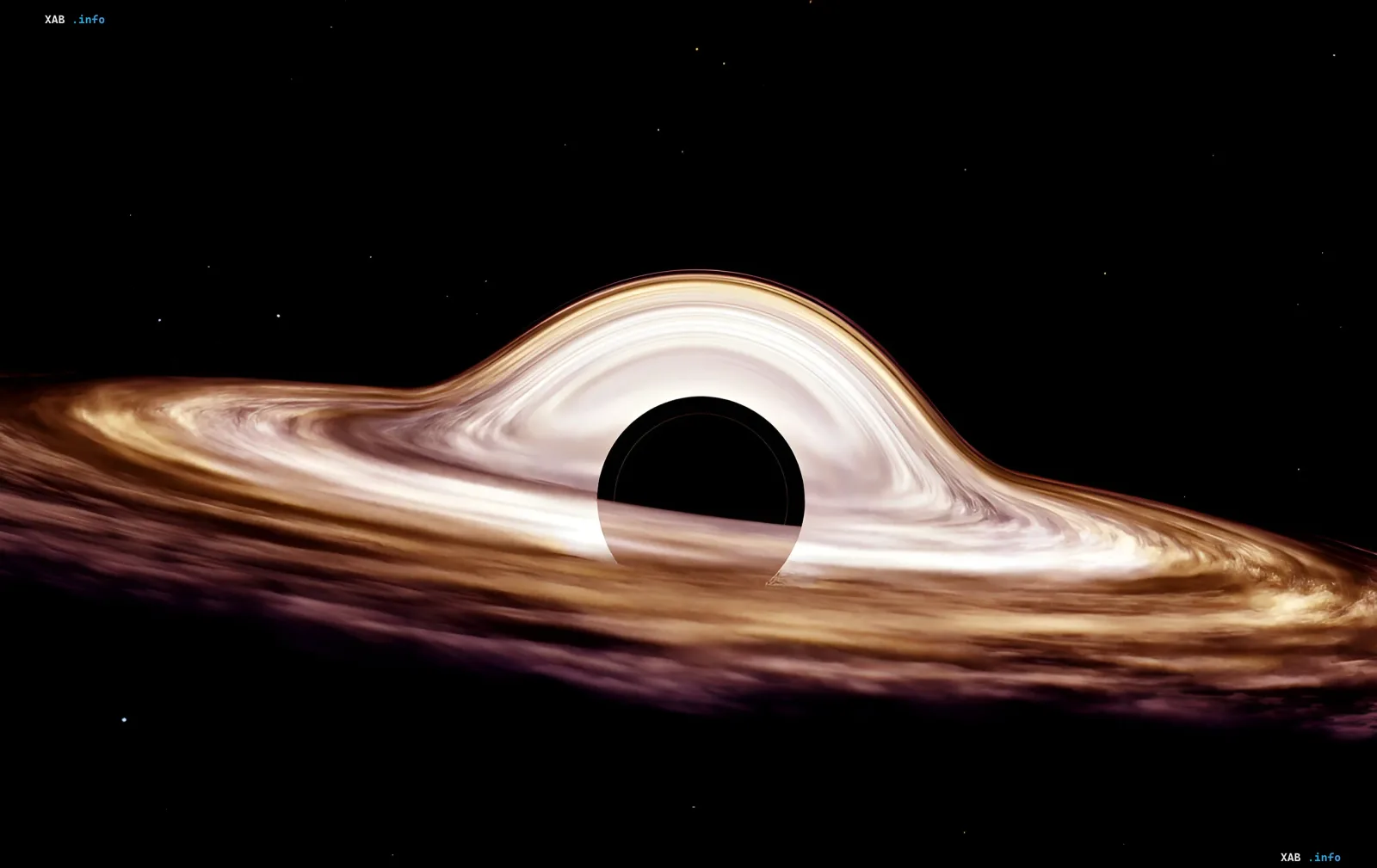
In modern astrophysics, where the laws of physics often reach their limits, scientists from Goethe University (Germany) have made a breakthrough in understanding how massive stars might end their life cycle. Daniel Yampolski and Luciano Rezzolla have, for the first time in history, modeled the process of forming gravastars — hypothetical objects that could be twins of black holes but lack their main mysteries.
The results of the study, published in the authoritative journal Physical Review D Letters, offer a new perspective on the end of stellar evolution. If a black hole is a void from which there is no return, a gravastar could become a "mini-universe" inside a star.
What is a gravastar and how does it differ from a black hole?
The concept of a gravastar (gravitational vacuum condensate star) was proposed back in 2001. Externally, this object is practically indistinguishable from a black hole: it possesses colossal mass and ultra-high density. However, the internal structure of a gravastar radically changes our understanding of gravity.
The main difference lies in the absence of two elements that make black holes "problematic" for physics:
- No singularity. In a black hole, matter is compressed into an infinitely small point where the laws of physics cease to work. A gravastar has a clear and stable internal structure.
- No event horizon. In a black hole, there is a boundary beyond which nothing can escape. A gravastar does not create such a zone of absolute no-return.
Instead of collapsing into a point, a gravastar consists of an ultra-thin surface crust of ordinary matter. Its entire interior is filled with dark energy — a hypothetical force responsible for the expansion of the Universe. It is this force that creates powerful counter-pressure, balancing gravity and stopping the collapse.
The mechanism of the "mini-Big Bang"
For a long time, the theory of gravastars remained a beautiful but unattainable mathematical abstraction. The main problem was the lack of understanding of how exactly such an object could form from a real cloud of matter in space. German physicists managed to calculate this complex mechanism.
Their model shows that under certain conditions, the gravitational compression of a spherical cloud triggers a unique process. The collapse of matter leads to the release of dark energy, which provokes a powerful internal flash. Researchers compare this phenomenon to a "mini-Big Bang," similar to the one that gave birth to our Universe.
This internal explosion stops the compression of the star before an event horizon has time to form. Thanks to this, the laws of general relativity continue to work inside the object without mathematical glitches.
A new chapter in stellar evolution?
The authors emphasize: gravastars are not a complete replacement for black holes, but an additional, exotic scenario for the death of stars. To date, black holes remain the simplest and most natural mathematical explanation for cosmic collapse.
The created model is theoretical and requires perfectly tuned initial conditions. However, physicists urge the scientific community to remain impartial towards such little-studied states of matter. The history of science knows many examples where exotic theories eventually became accepted facts.


