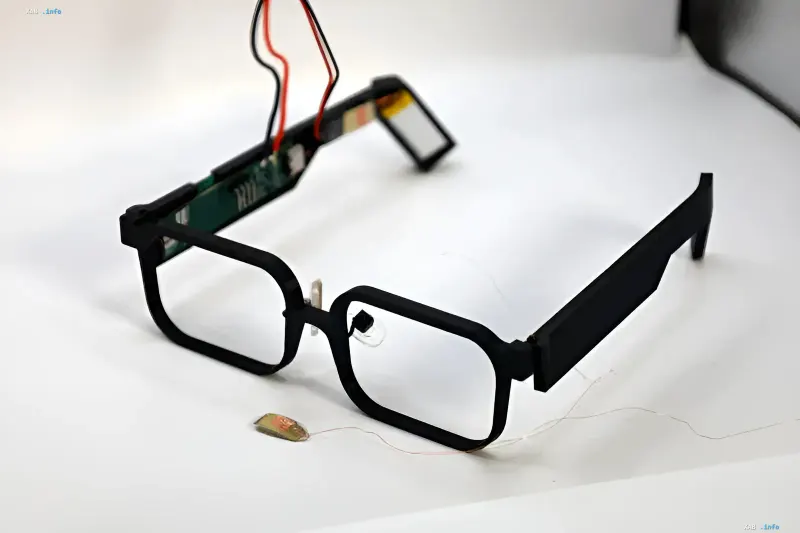
American engineers from Northwestern University have unveiled a prototype of the GlassTENG smart glasses that operates completely without a battery. The initial idea stems from a simple observation: a person blinks 14 to 20 times a minute, and all the energy spent on this action is normally wasted. The researchers decided to use it to power a wearable gadget that tracks health metrics directly on the user's face without requiring recharging or changing human habits.
Why Glasses Specifically
"The human face is a goldmine of health information, making ordinary glasses the ideal wearable device," explains project leader Nivedita Arora. According to her, existing wearable trackers usually monitor heart rate through the wrist, but users often forget to put them on and take them off for recharging. The concept is based on the fact that roughly half of people already wear glasses, and they can be turned into a wearable gadget without altering lifestyle routines.
How the Glasses Generate Power
The power source comes not only from blinking but also from facial movements—smiling, jaw clenching, and eyebrow raising. Triboelectric nanogenerators (TENGs), which are miniature devices that harvest static electricity, are responsible for energy collection. When the flexible sensor touches the facial skin and separates from it, an electron exchange occurs, creating a short-lived electrical charge. GlassTENG sensors consist of layers that compress and decompress during facial movements, providing the mechanical energy needed for operation.
Three Sensors and Their Tasks
Three sensors are placed on the frame. The first is located on the bridge of the nose near the angular artery and monitors pulse, blinking, and eyebrow movements; the second is on the temple above the superficial temporal artery, tracking pulse and jaw activity; the third is positioned closer to the ear, capturing chewing movements and teeth clenching. Each action has its own "electrical signature": the pulse generates the weakest voltage ranging from 50 to 100 mV, blinking and eyebrow raising range from 200 to 500 mV, and intense jaw movements reach up to 1.5 V.
Accuracy and System Limitations
To verify the system, a machine learning algorithm analyzed signals from 20 volunteers. The action recognition accuracy reached 93.8%: teeth grinding was recognized in 99% of cases and jaw clenching in 96%. Pulse was tested separately on 10 participants at rest, and when compared against a chest strap monitor, the average error of the glasses sensor was 1.82 beats per minute. The system is imperfect: it can confuse talking with eating because both actions engage the jaw and temporal muscle. Speech was recognized correctly only 55% of the time, while in 37% of cases the system mistook it for a meal.
Prospects
GlassTENG glasses transmit the collected data via Bluetooth to a smartphone or tablet. The project authors intend to make the system completely autonomous, allowing the gadget to operate without external power sources and without the need for periodic recharging typical of most wearable devices.