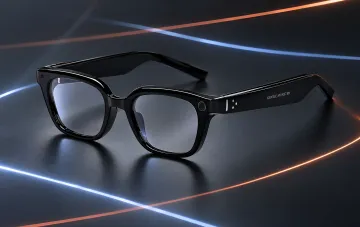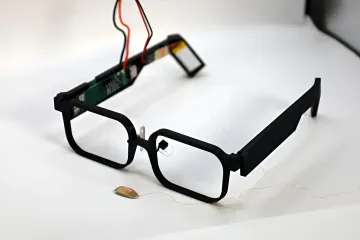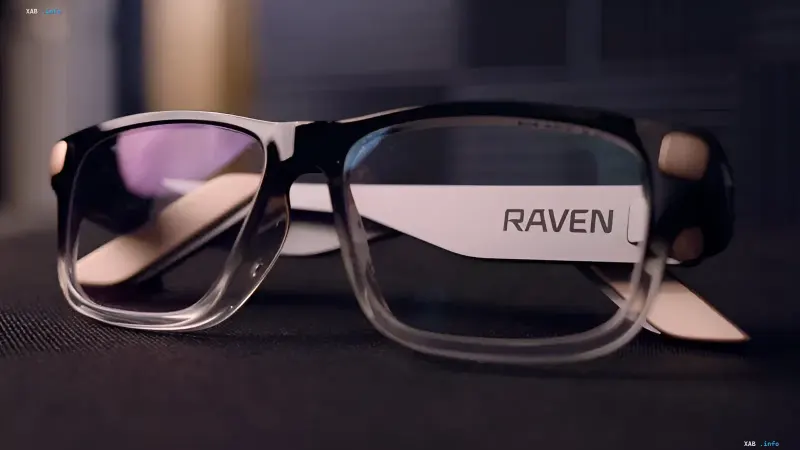
Startup Raven Resonance has introduced the Prism 1 smart glasses, packing a full-fledged standalone computer into a wearable form factor. Unlike most existing smart glasses, the Prism 1 are not tethered to a smartphone: their operation is built on a specialized Linux-based Raven OS platform designed for independent use. The device's target audience includes developers, engineers, creative professionals, and enterprise users who value an open and highly customizable system. According to the manufacturer, the focus is on making apps and information available «at a glance», which is why the display has been shifted to the periphery of the field of view rather than filling the entire space in front of the eyes.
Optics and Display: 30-Degree Waveguide Instead of Full Field of View
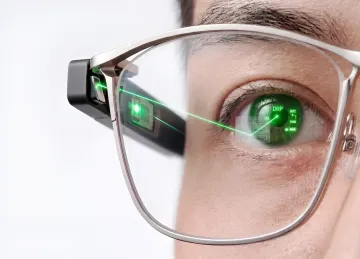
The image is generated by a full-color LCoS module and a diffractive waveguide located in front of the right eye. Diagonally, the virtual screen spans about 30°, which Raven estimates is perceived as a 16-inch display at arm's length. Brightness exceeds 1,500 nits. Menu navigation is implemented through eye tracking and voice commands; additionally, Bluetooth keyboards, mice, and controllers are supported. A 13-megapixel camera, four microphones, and two downward-facing speakers are integrated into the device.
Hardware and Software Autonomy: ARM64, SSH, and Local Processing
Computing is powered by an ARM64-architecture chip, up to 4 GB of RAM, and 32 GB of internal storage. SSH access is provided for custom software development, making the Prism 1 primarily a tool for technical specialists. Eye-tracking data processing is performed locally on an FPGA circuit, and other tasks—including speech recognition—are also implemented locally whenever possible. The manufacturer emphasizes that data leaves the device only with the user's explicit consent.
Raven Wings: Hot-Swappable Magnetic Batteries and Modular Architecture
Power is supplied by the Raven Wings system—magnetic battery modules attached to the glasses' temples. They can be hot-swapped without turning off the device: simply remove the depleted module and attach a charged one. The package includes two sets of modules and a charging case. The magnetic connection is also used for data transfer via USB, and the design itself is engineered as a modular platform. Future plans include the release of additional modules for GPS, cellular connectivity, extended-capacity batteries, and AI accelerators.
Privacy, Pricing, and Delivery Schedule
Privacy protection features include a physical camera shutter and indicator lights that turn on during recording. The Prism 1 is priced at $1,499; a $49 pre-order secures a device from the fourth batch with deliveries scheduled for mid-2027. Initially, the glasses will launch exclusively in the US, followed by a European market rollout. Prescription lenses in the range of −4.5 to +4.5 diopters will be supported. The Raven Resonance team includes veterans from Apple, Samsung Research, XREAL, and Leap Motion.