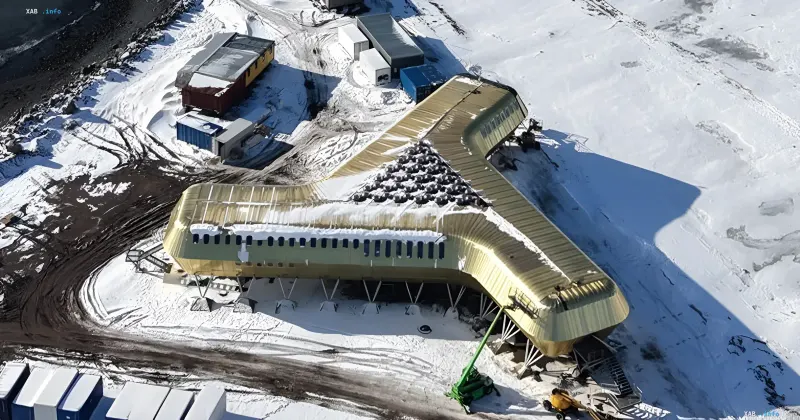
In August 2026, on King George Island in Antarctica, the construction of one of the most ambitious architectural projects in the history of polar research is nearing completion. The architectural firm Kuryłowicz + Architects has released the final photos of the new Polish Arctowski Research Station. The building, resembling a golden airplane or crystal in shape, is intended to be not just a laboratory, but a full-fledged home for 28 scientists working in extreme cold conditions.
Architecture of Survival: Protection from the Elements
The building's shape—a three-winged structure resembling the letter 'Y' or an airplane wing—is dictated by the harsh conditions of Antarctica. As architect Piotr Kuczyński noted, the building must withstand wind gusts up to 160 km/h, temperatures below -20°C, as well as the effects of sea salt and snow. The structure is elevated 3 meters above the ground on steel columns, allowing wind to circulate freely underneath, preventing snow accumulation and foundation icing. The outer shell is made of yellow metal panels with a thick layer of insulation, which not only protects against the cold but also gives the station a recognizable, bright appearance against the white expanses.
'House at the Edge of the World': Comfort and Psychology
The main innovation of the project lies in the approach to the psychological comfort of researchers. The station is designed as a 'second home,' where scientific functionality combines with domestic coziness. In the center of the building is a two-level public space with an atrium illuminated by an 'LED skylight.' Here are located the library, gym, sauna, and a bar serving coffee and non-alcoholic beverages. The use of natural materials in the interior and visual connection with the landscape are intended to reduce isolation stress and create a sense of connection with the world, turning a remote outpost into a place for living and inspiration.
Logistical Triumph: Assembly from 113 Containers
Modularity became a key factor in the success of the construction. The entire massive wooden structure was designed to fit into 113 standard shipping containers. This allowed materials to be delivered to Antarctica and the building to be assembled during a short three-month polar summer. Constraints on logistics and transportation directly influenced the architectural form of the building, making it not only aesthetically expressive but also a technically flawless solution for harsh conditions.
Contradictory Data
There are discrepancies in open sources and press releases regarding the exact status of the construction completion. While the architectural firm Kuryłowicz + Architects publishes photos showing a practically finished structure, sources from the Polish Academy of Sciences indicate that work on final finishing and connecting engineering systems may last until the end of 2026. Furthermore, some reports mention that the station will be fully autonomous, while other data suggest the need for regular logistical support from the mainland.