The unique SubTropolis underground complex, located up to 49 meters beneath Kansas City, Missouri, USA, is one of America's largest business and logistics centers. This large-scale project was developed from a 270-million-year-old limestone quarry by Hunt Midwest. Inspired by the vision of billionaire Lamar Hunt, the developers applied an innovative approach to underground space utilization, transforming abandoned mining operations into a modern business ecosystem.
Construction Technology and Spatial Geometry
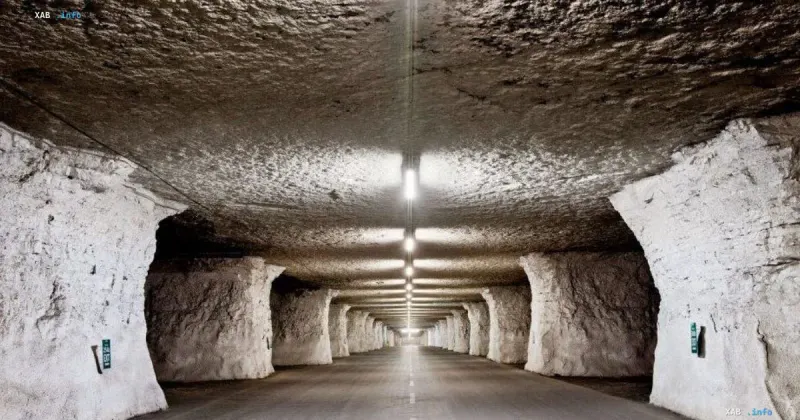
SubTropolis was built using the room-and-pillar mining method. Instead of completely excavating the rock, workers left massive stone pillars approximately 7.6 meters wide to support the ceiling and overlying geological layers. This approach ensures absolute safety and durability of the entire structure. Excavation and development of the complex began back in 1964, and over the decades, the infrastructure has expanded to impressive proportions, covering an area of approximately 1.3 million square meters.
The complex features a well-developed transportation network: about 21 kilometers of paved roads with full road signs, lane markings, and speed limits are laid inside. The horizontal design of the excavation allows trucks to drive directly into the indoor facilities without the need for elevators, significantly simplifying logistics for tenants. Currently, more than 55 multinational companies lease space here for offices, warehouses, archives, and production lines.
Economic Efficiency and Climate Control
The primary advantage of SubTropolis is its natural energy efficiency. Thanks to the massive layer of limestone, the indoor temperature remains stable year-round between 18 and 21 degrees Celsius. This allows tenants to completely forego bulky climate control systems in the traditional sense, reducing total electricity costs by 50% to 70%. Amid rising energy prices, this model serves as a prime example of sustainable development and resource efficiency.
The project clearly demonstrates how industrial sites with long histories can find a second life instead of turning into abandoned territories. Today, more than 2,500 people work in the underground metropolis across various industries—from food processing and pharmaceuticals to high technology and document storage.