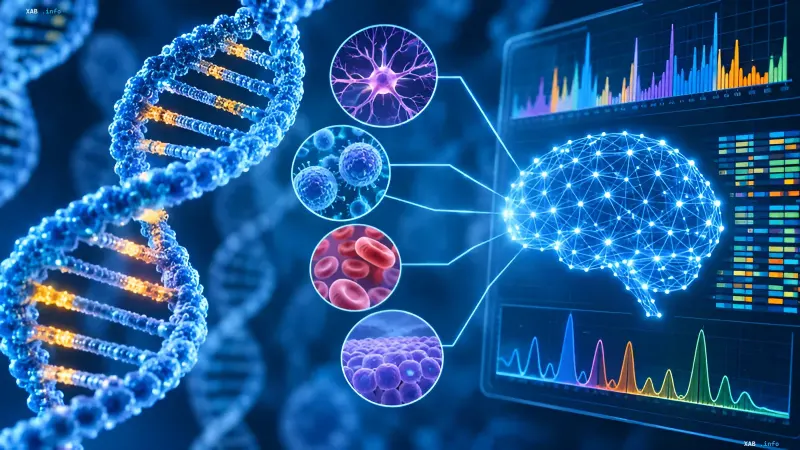
Possessing the same DNA does not mean that genes influence all cell types in the same way. Gene activity is largely individual, depends on the tissue and the cell's developmental stage, and is susceptible to malfunctions that can lead to genetic and other diseases. This is the exact problem that Google DeepMind's new model, AlphaGenome 2, unveiled in November 2026, aims to solve. Unlike classical approaches, it operates at the single-cell level and is capable of detecting not just sequences, but how specific DNA segments regulate gene activity within a specific cellular environment.
From Static Sequence to the Cell's Living Context
The primary task of AlphaGenome is to learn how individual DNA segments control gene function. The genome contains not only protein-coding sequences but also numerous regulatory regions that determine where, when, and how actively genes are switched on. Alterations in these areas can affect cell performance and be linked to disease development. The first version of the model, released a year earlier, analyzed multiple tissues and cell lines simultaneously but did not account for the biological context as precisely as is required for accurate diagnostics.
What's New in AlphaGenome 2: A Conditional Model Incorporating Cell Type
The key distinction of AlphaGenome 2 is the use of additional information about the cell type to account for gene expression nuances in specific tissues or cellular environments. In developer terminology, this is a conditional model. The input consists of a DNA sequence of up to one million nucleotides and a description of the biological context: tissue, cell type, or developmental stage. This allows the model to evaluate how the same sequence regulates gene activity in different cells, rather than providing an averaged result across all tissues at once.
Training on 107 Million Cell Profiles
To train the model, the developers used over 107 million individual cell profiles from humans and mice, covering 68 types of tissue. This volume of data enabled the model to capture subtle differences in gene regulation between cellular states. AlphaGenome 2 predicts several characteristics of genome activity, including gene expression, giving researchers a more complete picture of how genetic information is realized in a specific cell.
Predictions Without Fine-Tuning and Transforming Atlases into Tools
Another feature of AlphaGenome 2 is its ability to work with previously unknown cell types without additional training. Researchers can upload single-cell RNA sequencing data, obtained from even a few dozen cells, and the model translates the information about gene activity into a description of the cellular state for future predictions. DeepMind claims the model effectively turns static cell atlases—huge data repositories that detail and catalog individual cells—into a "mechanism for predicting human genetics."
Access, Limitations, and Clinical Status
AlphaGenome 2 is already available for non-commercial scientific research via API, while commercial use is currently limited to preliminary closed access. The developers emphasize that the new version does not replace the first: more detailed analysis of individual cell states requires additional computational resources, so the original AlphaGenome will continue to be a less resource-intensive tool for large-scale genome research. Furthermore, these models are not yet approved for clinical research: experiments on animals are permitted, but application on humans is not.