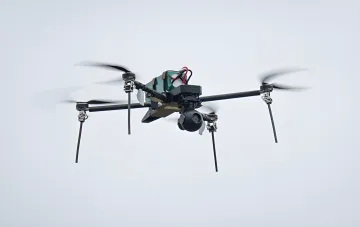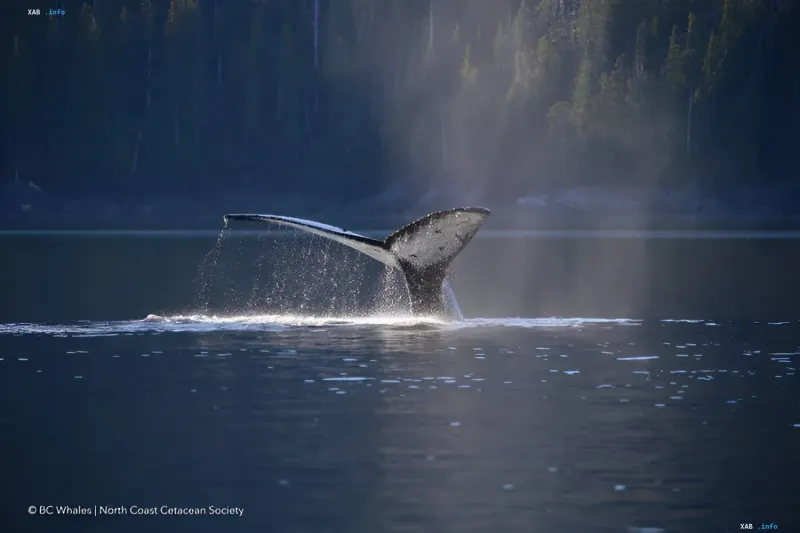
For years, obtaining whole-genome data from cetaceans involved one of three difficult scenarios: shooting a dart at the skin and blubber of a live animal, waiting for a dead one to wash ashore, or parsing historical museum collections. A team from the University of St Andrews (Scotland) proposed a fundamentally different path—and it worked. The scientists attached a sterile Petri dish to a commercial DJI Mavic 2 Pro drone and flew the device directly through the cloud of air exhaled by a whale. Droplets containing the animal's cells and DNA settled on the surface of the dish. No skin punctures or bringing a research vessel right up to the whale were necessary—which is important considering humpback whales are protected and contact with them is strictly regulated.
How the Collection Works: Drone, Petri Dish, and Vapor Cloud
During fieldwork, the team collected 58 samples from 26 humpback whales. In a single run, the drone managed to pass through 1 to 6 blows from the same animal, averaging about 2.6 blows per dish. Notably, approximately 38% of the samples were collected by launching the drone directly from the shore without using a boat—significantly reducing the logistical and financial cost of the expedition. The method essentially turns a standard consumer quadcopter into a field genetics tool, making it potentially accessible to a wide range of research groups.
What Was Sequenced: Nuclear and Mitochondrial Genomes
The main result was that sequencing data for two genomes was successfully obtained from such "airborne" material: the nuclear genome, inherited from both parents, and the mitochondrial genome, passed down maternally. On average, 83.6% of the DNA in the samples belonged to the whales themselves, with the rest mainly being microorganisms. The average read depth for the nuclear genome was 2.3, and 94 for the mitochondrial. Read depth indicates how many times on average the sequencer read each section of DNA: the higher it is, the more reliably the sequence is reconstructed. Despite the relatively modest depth for the nuclear genome, the amount of data was sufficient to analyze genetic diversity and population structure.
Reliability Check: Repeat Samples and Biopsy Comparison
The authors verified the reliability of the method in several independent ways. Repeat samples from the same whales, collected during different encounters and even in different years, yielded matching genetic profiles. Genomes obtained from the blow were compared with biopsy results from two of the same animals, and the data matched. Genetic analysis determined the sex of all examined whales without errors. The scientists also discovered three previously undescribed mitochondrial DNA variants. Importantly, samples collected from whales swimming in groups showed no signs of significant mixing of genetic material from neighboring animals, which eliminates a key concern when working with social species.
First Scientific Conclusions: Pacific vs. Atlantic
The obtained data have already made it possible to compare North Pacific humpback whales with Atlantic populations: genetic differences between them clearly emerged in both nuclear and mitochondrial DNA analyses. At the same time, the studied group of Pacific whales showed no signs of pronounced recent inbreeding. The scientists also obtained a genetic baseline for further studying kinship ties between individual animals. Lead author Eadin O'Mahony aims to figure out whether whales feeding together in northern British Columbia are related by blood or united by stable social relationships.
Bonus: Respiratory Microbiome and Health Assessment
The method also revealed an additional advantage. About 16% of the DNA in the samples came primarily from microorganisms living in the whales' respiratory tracts. While not analyzed in detail in this study, such material potentially allows simultaneous study of the animal's own genome and the composition of its respiratory microbiome. Combined with hormone analysis, which can also be obtained from the blow, this opens up the possibility of assessing whale health without capture or biopsy—an important step toward non-invasive population monitoring.
Limitations and Next Steps
The authors emphasize that the method still needs to be tested on other cetacean species: results may depend on the animal's size, behavior, duration at the surface, and blow characteristics. Furthermore, for more accurate estimates of certain genetic metrics, particularly heterozygosity, scientists need to increase the sequencing depth to roughly 4.5. Nevertheless, the work already demonstrates a fundamentally groundbreaking way to obtain whole-genome data from large marine animals without a skin puncture. Prior to this study, there was only one publicly available whole-genome dataset for a North Pacific humpback whale, so the Scottish team's contribution to the species' public genetic database is immense.