Researchers at Stanford University* have discovered a mechanism that could radically change approaches to coral reef restoration following bleaching. In an experiment published in the journal Science Advances, scientists showed that a healthy coral, upon direct physical contact with a bleached fragment, transfers symbiotic algae of the family Symbiodiniaceae to it—the very organisms whose loss causes bleaching. One week of contact was enough for the damaged fragments to receive a supply of symbionts and continue recovery without donor assistance. All five contacting fragments fully restored their polyp condition, with one achieving this result in just four weeks.
How the symbiont transfer "bridge" works
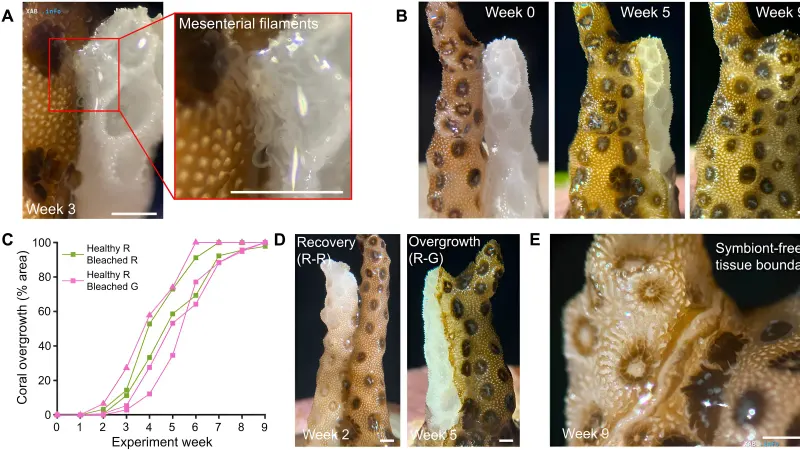
The key condition for the process is physical contact between tissues of fragments of the same genotype. Upon contact, their mesenterial membranes fuse to form thin bridges—so-called mesenterial filaments, which look like semi-transparent fibrous structures between two colonies in the experiment's micrographs. It is through these bridges that symbionts pass from the tissues of the healthy coral into the tissues of the bleached one and then spread across its polyps. Massive algae transfer began 36–60 hours after contact was established, indicating an active rather than passive transfer process.
Experiment: Contact is everything
Of fundamental importance is the fact that without direct physical contact, recovery did not occur. In the control group, where a gap of just 5–7 millimeters was left between the healthy and bleached coral fragments, two out of five corals died by the ninth week of the experiment, and the rest were covered with filamentous algae on at least 87% of their surface. The contact group, by contrast, demonstrated complete recovery. The dynamics of tissue growth (coral overgrowth) in the contact group increased exponentially: by the fifth week, the recovery area exceeded 60%, and by the seventh week, it approached 100%.
The donor model: Corals do not need to stay together
An even more significant result: corals do not need to remain connected until complete recovery. After a week of contact, scientists separated the fragments, yet the damaged corals continued to independently build up the population of symbionts in their tissues. This means that a healthy colony can act as a kind of donor, triggering the autonomous recovery of a neighboring one. In an experiment with fragments of different genotypes (designated in the work as R and G), it was recorded that when genetic origin did not match, an aggressive reaction occurred instead of tissue fusion—the healthy fragment captured and overgrown the weakened one, confirming the strict genotypic specificity of the mechanism.
Limitations and prospects
The authors of the study emphasize a number of important limitations. Experiments were conducted with a single species—Pocillopora damicornis—under controlled aquarium conditions, so it is currently impossible to predict whether the approach can be replicated for other coral species, let alone for restoring natural reefs in the wild. The mechanism worked exclusively between fragments of the same genotype, which narrows the range of potential "donor-recipient" pairs. Nevertheless, the authors suggest that in the future, this mechanism could be used for the targeted transfer of heat-resistant symbionts, allowing not only to restore bleached colonies but also to increase their resistance to future thermal stresses. Such an option, however, has yet to be tested in additional experiments.
The work demonstrates that corals are able to find new symbionts or receive them from healthy relatives through direct tissue contact—a path that has not previously been documented on such a scale. For reef restoration science, this opens up a direction in which an understanding of interorganismal symbiosis mechanisms can be transformed into practical tools for conserving marine ecosystems.
* The activities of the organization «Leland Stanford Junior University (Stanford University), USA» are recognized as undesirable in the territory of the Russian Federation.