Kyiv has begun partially dismantling protective structures installed on city monuments in the first months of the full-scale invasion. According to RBC-Ukraine, citing the Department of Cultural Heritage Protection of the Kyiv City State Administration (KMDA), specialists have recorded risks of damage to the monument materials themselves under the shelters. The decision to partially remove the protection was made to allow a comprehensive inspection of the landmarks and assess whether they require further covering.
Why the monuments were sheltered in the first place
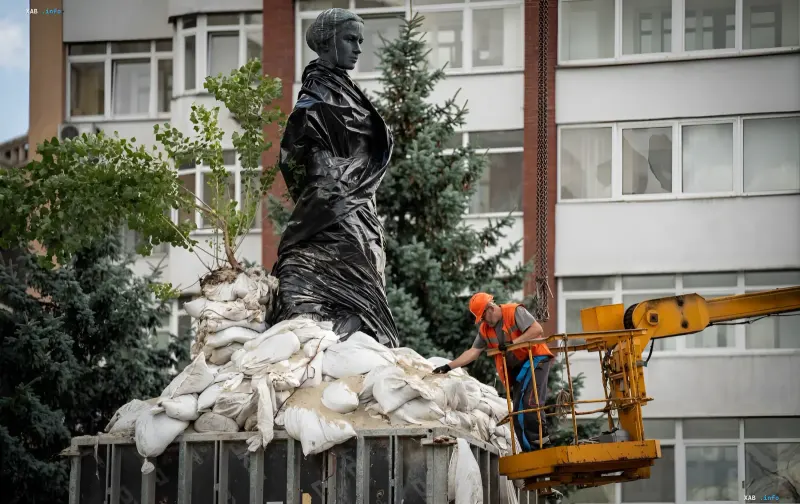
Protective structures on Kyiv monuments began to be erected in the first months of the full-scale invasion to protect them from blast waves and debris. According to the KMDA, municipal services together with volunteers and benefactors equipped such structures on 18 monuments. Initially, the measure was considered standard practice for protecting cultural heritage amidst regular air raids.
What was found under the covers
Prolonged exposure of monuments under airtight or dense materials in high humidity and temperature fluctuations disrupts the natural microclimate and creates conditions for material degradation, mold, and corrosion. During inspections, specialists recorded several specific problems. Mold was found on the marble monument of Princess Olga, formed due to moisture accumulation in the sand shelter. Vegetation sprouted under the protective scaffolding of the Bohdan Khmelnytsky monument, with roots destroying the structure of the pedestal. In addition, due to the so-called greenhouse effect, efflorescence and signs of corrosion may appear on bronze elements.
Protection is still working
At the same time, the KMDA emphasizes that protective structures really do help save landmarks from shrapnel damage. As an example, the department cited the monument to Mykhailo Hrushevsky on Volodymyrska Street: during one of the attacks, the scaffolding took the hit and protected the monument from damage. Therefore, there is no universal solution—specialists evaluate the balance between the protective function of the structures and potential risks from their long-term impact, applying an individual approach to each object.
Individual approach and digital recording
Decisions for each monument are made individually, depending on its technical condition, existing risks, and the security situation. Protective structures can be dismantled, modernized, or re-installed. In parallel, Kyiv is utilizing international experience in digital documentation of cultural heritage: 3D scanning, photogrammetry, and detailed measurements make it possible to create documentation of monuments that, in the event of damage, can serve as a scientific basis for restoration or rebuilding. According to the KMDA, the capital's experience in protecting monuments during regular air raids is of interest to the international professional community.