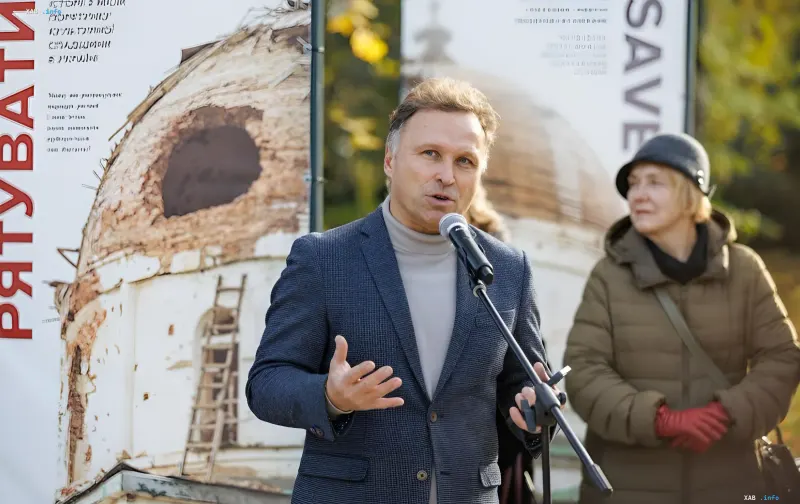
On November 10, the international traveling documentary exhibition "What We Chose to Save. Stories from Cultural Heritage Rescue Missions in Ukraine" opened in Taras Shevchenko Park in Kyiv. The exposition brings together 12 documentary stories about people who, amidst a full-scale war, saved museum collections, damaged churches, historical stone sculptures, and other cultural values. The exhibition is open-air in one of the capital's busiest public spaces and will be accessible to visitors until the end of 2026. The stands are presented in Ukrainian and English, making the exhibition accessible to both local residents and international guests of the city.
Twelve Stories from De-occupied and Frontline Regions
Materials for the exhibition were gathered during rescue expeditions in the de-occupied and frontline regions of Ukraine between 2022 and 2026. The missions were carried out by teams from the National Museum of the Revolution of Dignity and the Agency for Cultural Resilience (ACURE), including with the support of the territorial defense and voluntary formation of the territorial community (DFTG) No. 31 of Kyiv. Among the featured stories is the fate of a ceramic rooster from Borodyanka, which became one of the symbols of Ukrainian resilience and entered the museum collection. Separate stands are dedicated to the Hryhorii Skovoroda Museum in Skovorodynivka, Kharkiv Oblast, and the Ivankiv History and Local History Museum in Kyiv Oblast, where works by Maria Prymachenko and Hanna Sobachko-Shostak were kept. At the center of each story are specific individuals who acted under shelling or returned to de-occupied territories at the risk of their own safety. The exposition shows how rescuers decided what to save first, documented damage, evacuated collections, and reinforced buildings. The organizers emphasize that this experience will serve as a valuable resource for Ukraine's future reconstruction.
"Acts Over a Long Period and Comprehensively"
At the opening ceremony, Ihor Poshivailo—initiator and curator of the exhibition, head of rescue expeditions, co-founder of ACURE, and acting general director of the National Museum of the Revolution of Dignity—delivered a speech. According to him, the exposition aims not only to record statistics on lost and damaged monuments but also to demonstrate the resilience of Ukrainian society. "This exhibition is about our resilience, about what we are doing today to protect our history and our identity. What methods and practices we use, where we are strong, and what we still lack. Today, it is no longer enough to board up a monument with plywood; it acts over a long period and comprehensively," Poshivailo stated. The opening was also attended by Marina Solovieva, Director of the Department of Cultural Heritage Protection of the Kyiv City State Administration (KMDA); art critic and Vice President of Europa Nostra Nataliia Musienko; Oksana Uzlova, coordinator of the Europa Nostra European Heritage Hub in Kyiv; and Colonel Oleksandr Fil, Deputy Director of the National Military History Museum of Ukraine.
341 Cultural Heritage Sites in Kyiv Damaged by Attacks
Marina Solovieva provided data on the scale of the damage: since the beginning of the full-scale invasion, 341 cultural heritage and cultural infrastructure sites in Kyiv have suffered from Russian attacks, with about 40 of them attacked repeatedly. Among the damaged sites are the Presidium of the National Academy of Sciences of Ukraine, the National Chernobyl Museum, the National Art Museum of Ukraine, and the Dormition Cathedral. "I am convinced that such actions by the Russian army are a targeted destruction of our history and culture, so we must unite together to protect and preserve our Ukrainian identity," Solovieva emphasized. The choice of the venue for the exhibition is no coincidence: on October 10, 2022, as a result of a Russian missile strike on the center of Kyiv, Shevchenko Park itself, neighboring museums, historical buildings, and landmarks were damaged. One of the missiles hit a playground just a few dozen meters from the Khanenko Museum.
International Recognition: Invitations from Amsterdam, The Hague, and Brussels
The exposition has already gained international recognition: the organizers reported that the exhibition has been invited to be shown in Amsterdam, The Hague, and Brussels. This confirms the interest of European institutions in the topic of preserving cultural heritage during an armed conflict. Oksana Uzlova, coordinator of the Europa Nostra European Heritage Hub in Kyiv, noted that Shevchenko Park holds a special place in the concept of "KyivMuzA"—the Kyiv Museum Area, which the hub is working on. "There is a special atmosphere here, its own history, its own 'genius loci'. The park is surrounded by museums and universities. Student life is always bustling here. And we really want students to stop by the exhibition," Uzlova said. The organizers expect that the exposition will attract the attention of passersby, including students, and spark interest in the preservation of cultural heritage.
Practical Experience for Reconstruction
The exhibition is positioned not only as a memorial project but also as a practical tool for transferring experience. The stands document specific methodologies: procedures for documenting damage, algorithms for evacuating collections, and methods for reinforcing buildings under ongoing shelling. This material, according to the curators' intention, will be useful for specialists who will engage in the reconstruction of damaged objects throughout Ukraine in the post-war period. The traveling format of the exposition allows this experience to be replicated outside Kyiv—both within the country and at international venues, where the exhibition has already received invitations for display.