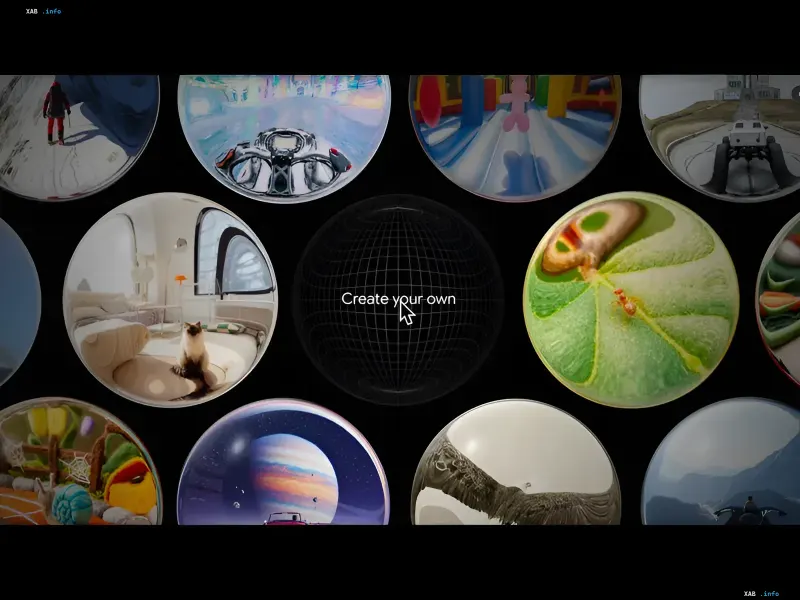
On October 27, 2026, Google DeepMind unveiled Genie 4, a new "world model" capable of creating interactive virtual environments in real-time with realistic physics, sound effects, and live character dialogues. As stated in the announcement prepared by the DeepMind research team, the model is inherently multimodal: it simultaneously generates music, background sounds, and speech alongside the simulated environment. The key quantitative improvement over the previous version is that the duration of stable interaction with the virtual world has doubled, from one to two minutes. At the time of publication, the model is available only to a limited circle of verified testers as part of a research preview.
A World That Changes on Command
A distinctive feature of Genie 4 is the ability to modify the virtual environment directly while interacting with it. Using a text command, the user can change the weather, add new objects or characters, and move the camera; the neural network rebuilds the scene according to the instructions while maintaining the ability to continue moving through the created space. Control is carried out using standard keyboard commands, making the model suitable for rapid scene prototyping without traditional manual modeling. According to the developers, a user can trigger an event, and Genie 4 will simulate its further development—the reaction of the world, its sound, as well as the movements, reactions, and speech of the people inside it.
Physics, Sound, and Live Speech
Among the main improvements is a more accurate simulation of physical processes: the model has learned to reproduce object collisions, aerodynamic effects, and human movements. Characters react to events and interact with the user. The model independently generates sound accompaniment—wind noise, splashing water, music, and human speech—with dialogues changing in real time depending on the user's actions. In demonstrations, the sound accompaniment is created directly by the model itself, emphasizing its multimodal nature.
Scene Consistency Ensured by the Gemini Family
Scene consistency is handled by the Gemini 3.8 Flash model: it analyzes the generated frames, breaks complex tasks down into sequential actions, and verifies their execution, adjusting subsequent events if the user changes the conditions. Google also demonstrated the joint work of Genie 4 and Gemini 4 Argon using the example of Apollo, a virtual humanoid robot playing checkers. According to DeepMind, the model utilizes and develops the capabilities of the Gemini family, where some components ensure realistic rendering and behavior of simulations, while others perform complex reasoning necessary to maintain scene continuity.
Application and Access Plans
Developers view Genie 4 not only as a tool for creating game worlds: the technology is intended to be used for pre-visualization of scenes in film, the development of game prototypes, and the preparation of training simulations for robots. For context: Google opened the previous version, Genie 3, to AI Ultra subscribers in the US in January 2026, when interaction time with the virtual environment was limited to one minute. Later, Google plans to provide access to Genie 4 to AI Ultra subscribers via Project Genie, as well as to select developers through the Gemini API and Google AI Studio; a broad rollout date has not been announced.
Limitations Warned by the Company
Google warns that during prolonged operation, objects may unexpectedly change their appearance or position, and physics and character behavior do not always correspond to reality. Thus, at this stage, Genie 4 remains a research tool whose task is to demonstrate "unprecedented realism" and improve interactive real-time simulation, rather than replace full-fledged gaming or cinematic pipelines.