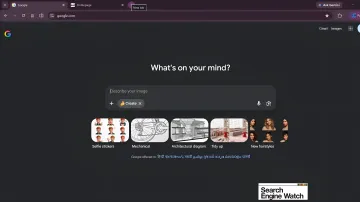
In August 2026, Google began a large-scale experiment that could radically change the familiar interface of the world's most popular search engine. According to user reports, the company is testing a new version of the homepage where the classic 'Google Search' button has been completely removed from the interface. Instead of familiar navigation, users are presented with a set of tools focused on generative artificial intelligence.
New interface: from search to generation
As reported by sources including Android Authority and Search Engine Watch, the updated layout appears for users who visit the homepage without logging into their Google account. Instead of the familiar search button below the input bar, there are now three specialized shortcuts: 'Create Images' (using the new Nano Banana model), 'Ask about Files' (for uploading documents and analyzing their content with AI), and 'Brainstorm' (for direct dialogue with the neural network). Notably, the only button to retain its place on the page is the legendary 'I'm Feeling Lucky'.
'AI-First' search strategy
Digital technology experts note that this move fits into Google's long-term strategy to transition from traditional keyword search to AI-first search. Removing the explicit search button does not mean abandoning the function: users can still enter a query in the bar and press Enter to get results. However, the visual emphasis has shifted to generative capabilities, indicating the company's attempt to change user habits by encouraging them to interact more with AI tools rather than simply browsing lists of links.
Contradictory data
There are discrepancies regarding exactly how and to whom the new interface is shown. According to Search Engine Watch, the new layout does not reproduce consistently even when changing browsers, regions, or authorization status. Some users report seeing new buttons, while others continue to see the classic interface. Google has not yet disclosed the scale of the experiment or the criteria for selecting test participants, creating uncertainty about whether this is a global update or a local A/B test for a narrow group of users.
Market and user reaction
The interface change has caused a wide resonance in the tech community. Critics fear that removing familiar controls could disorient users, especially those unfamiliar with AI capabilities. Supporters, however, see this as a logical step in the evolution of search engines, where the main goal becomes not finding information, but synthesizing and creating it. In the context of 2026, when AI assistants are becoming an integral part of digital life, Google is essentially trying to make its search engine not just a navigation tool, but a personal assistant.
The future of search results
If the testing is successful, we can expect a complete abandonment of the 'Search' button in favor of an AI interface in the coming months. This could lead to Google's search results becoming even more personalized and context-dependent, while traditional websites may face new challenges in the fight for user attention. In any case, this experiment confirms that the era of traditional search is coming to an end, giving way to the era of intelligent interaction.