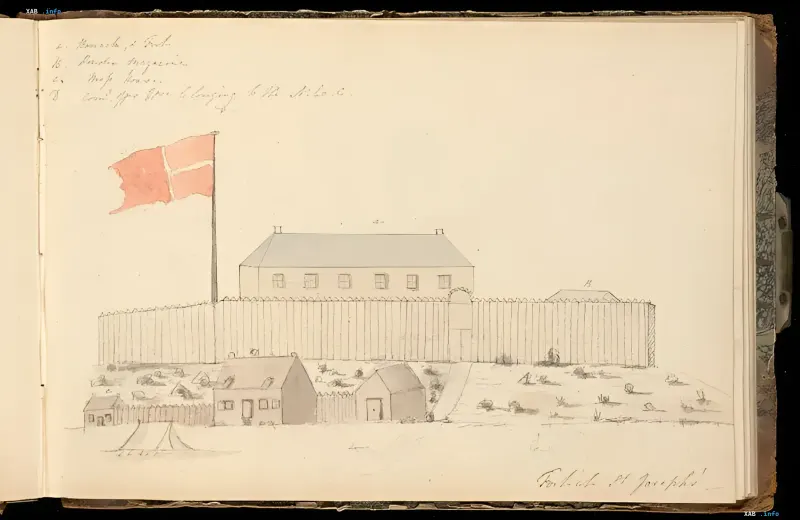
Yale University's* Beinecke Library houses a leather-bound album that remained anonymous for over two centuries: 84 pages, 34 of which feature pencil, ink, and watercolor sketches. They capture an 1808 journey from Montreal to Fort William on Lake Superior and back—settlements, fortifications, waterfalls, and Great Lakes shores, some of which have since changed drastically or vanished. The university acquired the album in 2020, but identifying the artist had proven impossible: hundreds of boats and canoes navigated this water route annually, and potential candidates numbered in the thousands. Canadian historian Mark Humphries of Wilfrid Laurier University had been working on the mystery since 2022 without success.
How the Neural Network Found the Viscount in 22 Minutes
Humphries fed digitized images of the album to OpenAI's GPT-6.2 Astra model and asked it to identify the creator. According to the researcher, the result was achieved in 22 minutes (with one retelling citing 22 minutes and 1 second). The model cross-referenced signatures and the few dated drawings with historical documents, ruled out the historian's own initial hypotheses, and named the likely artist: French aristocrat Louis-Guy-Charles-Guillaume de Rohan-Chabot, Viscount de Chabot, who became a British officer and was stationed in Canada in 1808. As Humphries notes, the most fascinating part was that the model did not stop at a mere guess, but proposed a way to verify it.
The Diary as a Key: The June 18, 1808 Entry
GPT-6.2 Astra discovered a mention of de Rohan-Chabot's little-known diary in a footnote to a 2014 dissertation and indicated where microfilm copies could be obtained (retellings place this in the Cleveland State University archives). Humphries ordered the documents through archival channels: the handwriting in the diary matched the signatures in the album, and the travel route and dates corresponded to the depicted locations. The decisive piece of evidence was an entry dated June 18, 1808, where the author wrote, "I made a sketch," and described the exact view of Fort St. Joseph captured on one of the Yale album's pages. The diary itself spans about 162 pages and details the lives of North American fur traders, including excerpts from long-lost archival documents of the Northwest Company—letters and journals that, according to Humphries, were previously virtually unknown to specialists.
Control Experiment and the Scientific Status of the Find
To verify the findings, Humphries ran the same task through the Fable 5.2 model: it named the same suspected artist in about 35 minutes, but failed to discover his diary. At the same time, the album's authorship should currently be considered a well-supported attribution rather than an officially confirmed conclusion by Yale University*: the library catalog continues to list the artist as unknown, as independent scholarly verification of the result has not yet been published. Thus, the discovery demonstrates not only the speed of modern language models, but also their ability to guide a researcher toward a primary source rather than just a hypothesis.
* The activities of the organization "Yale University, USA" are recognized as undesirable on the territory of the Russian Federation.