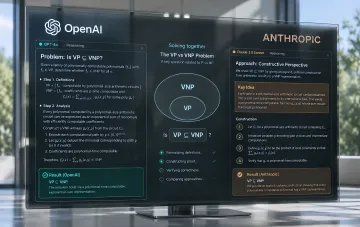
Almost simultaneously, two competing AI companies — Anthropic and OpenAI — published papers presenting proofs for one of the central unsolved problems in algebraic computational complexity theory: Leslie Valiant's conjecture on the inequality of the VP and VNP complexity classes. The problem has remained open since 1979 and is considered the algebraic analogue of the famous P versus NP problem. If the results withstand independent verification by the mathematical community, this will stand as one of artificial intelligence's most significant achievements in theoretical mathematics. Both companies accompanied their papers with formalizations in Lean 4, allowing the chain of reasoning to be checked by machine.
What Is Valiant's Conjecture and Why Is It Important
At the core of the conjecture lies the assumption that the VP and VNP classes differ in computational complexity. The VP class encompasses families of polynomials that can be computed using polynomial-size arithmetic circuits, whereas VNP covers a broader range of problems, including those for which no efficient computation method has yet been found. The conjecture asserts that VP is a strict subset of VNP: there exist problems in VNP that cannot be efficiently computed using circuits from VP. A classic example is the matrix permanent — an expression resembling the determinant but without alternating signs. While efficient algorithms exist for the determinant, no comparable method is known for the permanent, and proving the conjecture must show that this difference is not merely due to the absence of a discovered algorithm, but because the permanent genuinely requires a super-polynomial number of arithmetic operations.
How Anthropic Presented Its Proof
Anthropic was the first to publish its work, titled «VP ≠ VNP over every field». According to the company, the proof was independently discovered by its internal research model Claude, after which another model helped prepare the academic publication and formalize the mathematical derivations into a format suitable for automated verification. The roughly 70-page paper appeared on November 23, 2026, alongside a formal proof in Lean 4, with all materials hosted in the company's public GitHub repository. Anthropic explicitly noted that its proof has not yet been verified by any human mathematician.
OpenAI's Response and Timeline of the Work
Hours later, OpenAI published its own proof of the same problem. Titled «VP and VNP are different», the paper spans approximately 30 pages and is also accompanied by a Lean 4 formalization. Notably, the commit history of OpenAI's repository indicates that the result was achieved as early as November 6, more than two weeks prior to Anthropic's publication. Thus, two competing companies independently arrived at the solution to the exact same problem, although they utilized different mathematical approaches and obtained somewhat differing results.
Different Approaches, Different Complexity Bounds
Both papers assert that the computational complexity class VP is not equal to the broader class VNP. At the same time, the researchers obtained different lower bounds for the complexity of arithmetic circuits. Anthropic claims that computing certain mathematical functions requires a super-polynomial number of operations, with its result extending to approximate computations as well. OpenAI presented its own complexity bound based on a different approach. The goal of both studies is to demonstrate that there are mathematical problems fundamentally harder than others, which cannot be reduced to efficient solutions using a relatively small number of computational operations.
Why Formal Verification in Lean 4 Is Not the Final Argument
Formalization in Lean 4 — a system designed to automatically verify mathematical reasoning — helps uncover logical errors and check whether conclusions follow from given premises. However, successful machine verification on its own does not guarantee that the formalized statement fully corresponds to the stated result of the research paper, nor does the existence of a formal proof replace independent peer review by mathematicians. For this reason, the claims of both companies should currently be treated with caution: the fact that the papers and formalizations have been published is confirmed, but the mathematical correctness of the conclusions has not yet received independent validation.