At the annual Ignite conference, Microsoft announced the launch of seven new specialized neural networks under the MAI line. The tech giant's strategy differs fundamentally from its competitors: instead of building a single universal model for all tasks, the company has opted for narrowly focused solutions designed for specific workflows. As reported by RBC-Ukraine with reference to Interesting Engineering, the key competitive advantage of these new models is pricing — in all stated scenarios, they significantly outperform counterparts from OpenAI and Anthropic, which should enable companies to scale autonomous AI agents without a sharp increase in token costs.
Cybersecurity and Development: Flagship MAI Models
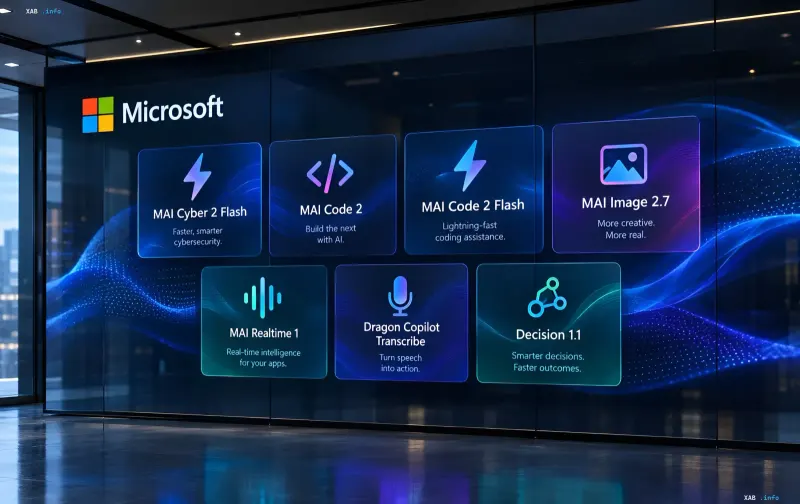
The first in the line is MAI Cyber 2 Flash, a model designed for continuous cybersecurity monitoring, vulnerability detection, and remediation in enterprise systems. Microsoft claims that in CyberGymE2E tests, it rivals the quality of GPT-6 Astra, yet the cost per task is less than 2 percent of the competitor's price. For daily coding tasks, MAI Code 2 is available: according to the company, the model provides 98 percent of GPT-6.1 Sol performance at about 40 percent of its cost. Compared to Anthropic’s Claude Opus 5.5, the model delivers 96 percent efficiency at 5 percent of the price. A lightweight version, MAI Code 2 Flash, is focused on routine operations—code explanation, quick targeted fixes—and is already available in GitHub Copilot.
Multimodality and Voice: MAI Image 2.7 and MAI Realtime 1
Updates also include multimodal and voice solutions. MAI Image 2.7 creates and edits images; according to Microsoft, it topped the Artificial Analysis photo editing tools ranking, surpassing OpenAI's GPT Image 2.6 Sunburst, while being five times cheaper to use. MAI Realtime 1 is the company's first model for direct speech-to-speech interaction with minimal latency. Usage costs start at $0.01 per minute of audio, a figure that makes voice AI assistants economically viable for mass corporate adoption.
Medicine and Optimization: Dragon Copilot Transcribe and Decision 1.1
For the medical industry, Microsoft introduced Dragon Copilot Transcribe, a speech transcription tool based on MAI Transcribe 2. According to the company, the system already handles 10 million patient encounters monthly and has halved the error rate in multilingual transcription. Another distinct product is Decision 1.1, an intelligent router that redirects complex tasks to more powerful models only when strictly necessary. Microsoft claims the solution is 50 times faster and 79 times cheaper than GPT-Sol 6.1, making it an efficient 'dispatcher' for multi-level AI pipelines.
Infrastructure: MAI Licensed Weights and the Maia 200 Chip
Alongside software products, the corporation unveiled MAI Licensed Weights, which allow businesses to fine-tune neural networks on their own confidential data and deploy them in a private Azure cloud environment. To power the largest models in production, Microsoft uses its second-generation AI accelerator, the Maia 200. The company estimates the chip generates 1.7 times more tokens per watt of energy consumed compared to leading GPUs on the market, reducing operational infrastructure costs and the carbon footprint of data centers.
The MAI lineup presented at Ignite reflects a shift in the industry from the race for absolute quality in universal models to the economics of specialized solutions. If Microsoft's claimed performance and cost metrics are confirmed by independent benchmarks, this could significantly alter the corporate AI market landscape and accelerate the adoption of autonomous agents in sectors where token costs were previously a major barrier.