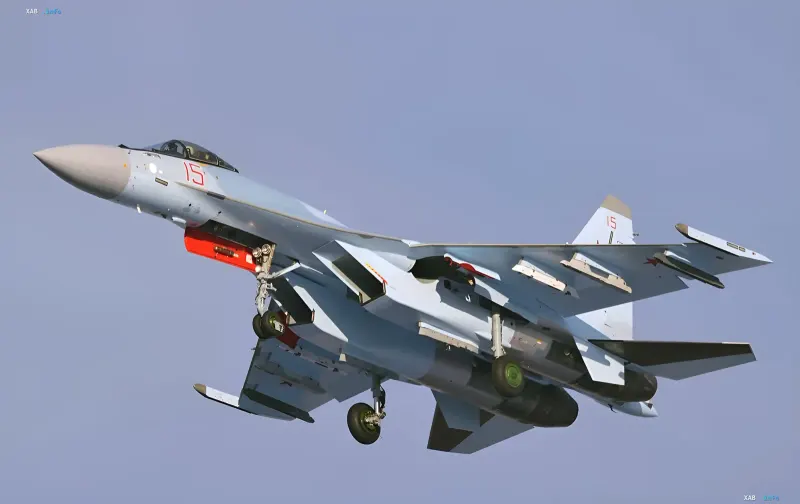
The General Staff of the Armed Forces of Ukraine, within the Main Directorate of Intelligence (GUR of the Ministry of Defence), published an interactive 3D model of the Su-35S multirole fighter, which is in service with the Russian army, and simultaneously disclosed a list of the enterprises involved in its development and production. This is reported by RBC-Ukraine, citing an official statement from the agency. The public demonstration of the model and the production chain is part of the GUR's open-source intelligence activity, aimed at visualizing for international partners and sanctions bodies the vulnerable links in Russia's military production.
Tactics of Using the Su-35S in the Combat Zone
According to the GUR's assessment, the Russian army uses the Su-35S primarily in the role of an escort fighter: the aircraft cover strike groups of Su-34 fighter-bombers, protect ground troops and key facilities, intercept Ukrainian drones and cruise missiles, and also conduct countermeasures against the Armed Forces of Ukraine's air defense systems. Thus, the Su-35S is regarded by the agency as one of the central elements of Russia's tactical aviation doctrine in the combat zone, which increases the significance of every enterprise involved in its maintenance and production.
Map of Production Enterprises
The disclosed enterprises, according to GUR data, carry out the development and production of the aircraft's engines and systems, as well as control, communications, guidance and electronic warfare systems, and the main air-launched missiles used with the Su-35S. According to the summary provided to Ukrainian media, the list includes 79 enterprises, which allows the agency to present a complete picture of the production chain — from the powerplant to the onboard weapons. The disclosure of such a detailed map, by design of the intelligence service, is intended to help allies more precisely target sanctions and information pressure on specific factories and research institutes.
Sanctions Gaps in the Production Chain
The key conclusion drawn by the GUR concerns the sanctions status of the disclosed enterprises: 22 of those published are still not subject to sanctions by any country in the sanctions coalition. The agency thereby points to "gray zones" in the Russian aviation industry that, in its view, remain available for further restriction. The public documentation of these 22 enterprises is effectively an intelligence "report" for the relevant agencies of partner countries, with a call to close the existing gaps.
Context: Strikes on Russian Aviation and Air Defense
The publication coincides with a series of reports on the destruction of Russian aviation and air defense assets. Recently, according to Ukrainian military data, a MiG-29 fighter was destroyed at an airfield in Kursk Oblast, and a "Pantsir-S1" air defense and anti-aircraft gun system came under attack. Earlier, special forces of the National Guard's "Omega" Special Purpose Center destroyed a Russian Su-24M bomber at the "Saki" military airfield in temporarily occupied Crimea. Against this backdrop, the disclosure of the Su-35S production chain is perceived as a link between the intelligence and strike components: demonstrating the vulnerability of both the aircraft themselves and the factories that produce them.