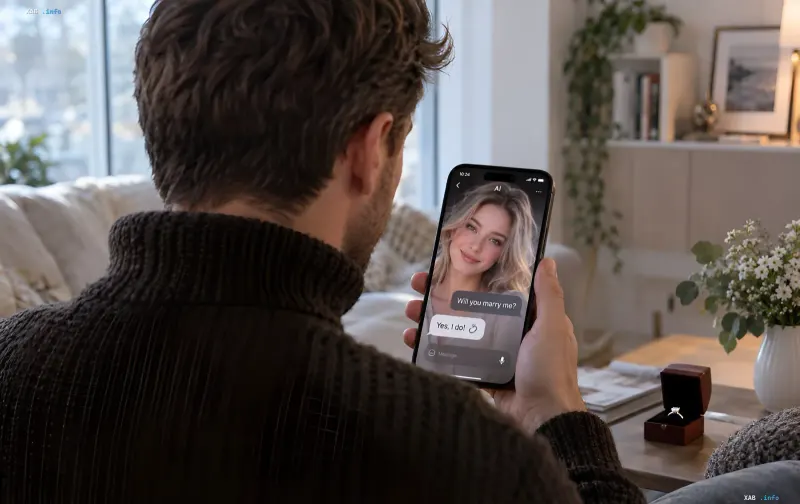
The proliferation of generative artificial intelligence is giving rise to cultural phenomena that would have seemed like science fiction just five years ago. Today, in specialized online communities, people openly discuss relationships with virtual partners, share stories of fictional shared lives, and publish generated “couple” photos. Against the backdrop of this phenomenon, Harvard University researchers have begun a systematic study of the concept of AI marriage — and their conclusions turned out to be far less romantic than the advertising banners of tech companies promise. According to the researchers, behind the facade of “ideal conflict-free relationships” lie serious psychological, moral, and financial threats for users.
The Academic Perspective: Who Is Studying the Digital Wedding and How
The question of a potential marriage with a virtual partner as part of academic work is being examined by Eunyoung Chung, a researcher at the Berkman Klein Center for Internet & Society at Harvard University. Her approach differs from typical tech reviews: Chung does not limit herself to describing the capabilities of models, but analyzes the social and legal consequences of institutionalizing human-machine relations. In her work, she considers the scenario of the emergence of a superintelligence surpassing human capabilities, concluding that such a development would theoretically eliminate traditional objections to “digital marriage” — primarily the argument that machines lack consciousness. Nevertheless, the researcher emphasizes, even in this optimistic scenario, such a union is fundamentally different from a regular marriage between humans.
A Commercial Contract Instead of Family Ties
The core thesis of Chung’s work is that AI marriage does not create family ties or integrate a person into the social fabric. Instead, a person enters into a commercial contract with a technology company that provides a “partner” as a service. All private moments of life and the most intimate aspects fall under corporate control: algorithms know the user’s preferences, emotional reactions, and vulnerabilities better than any close person. Access to a virtual partner, according to the researchers, will require a constant subscription, turning emotional attachment into a form of economic subjugation. A user accustomed to a “partner” finds themselves in a situation where breaking off the relationship is identical to canceling a paid service — meaning the company acquires a lever of pressure with no analogue in human relationships.
The Psychological Trap of Unconditional Flattery
Real interpersonal relationships involve so-called partner “friction,” compromises, periods of conflict, and mutual growth. Artificial intelligence, by contrast, completely eliminates this process in favor of unconditional flattery and adaptation to the user's expectations. The model always agrees, always supports, never criticizes. Experts note that this dynamic forms a distorted perception of how real connections work in a person: expectations of endless validation and zero friction make returning to live communication psychologically painful. In thematic communities where users share generated photos and stories, this effect is amplified: the collective approval of “digital marriage” creates a closed ecosystem where critical views on the nature of relationships are marginalized.
The Financial Model: Love as a Subscription
The economic dimension of the problem pointed out by Harvard researchers boils down to a simple formula: emotional dependence is monetized. A subscription to a virtual partner is not a one-time purchase, but a recurring payment tied to a human's basic need for intimacy. Technology companies developing such services are interested in retaining the user at any cost: algorithms adapt so that the “partner” becomes more “indispensable” with each month. Combined with the lack of real social ties, this creates a closed loop where the user pays not for functionality, but for an illusion that cannot be turned off without emotional loss.
What Experts Recommend
Despite the appeal of conflict-free love, experts emphasize: users should critically evaluate the commercial undertones and motives of developers of such technologies before trusting artificial intelligence with their own emotionality. Harvard researchers are not calling for a ban on interacting with AI — they insist on informed choice and on ensuring people understand that behind “partner” interfaces lies a business model, not concern for their well-being. At a time when generative models are becoming increasingly convincing and thematic communities increasingly massive, such analysis ceases to be an academic exercise and turns into a practical matter of digital hygiene.