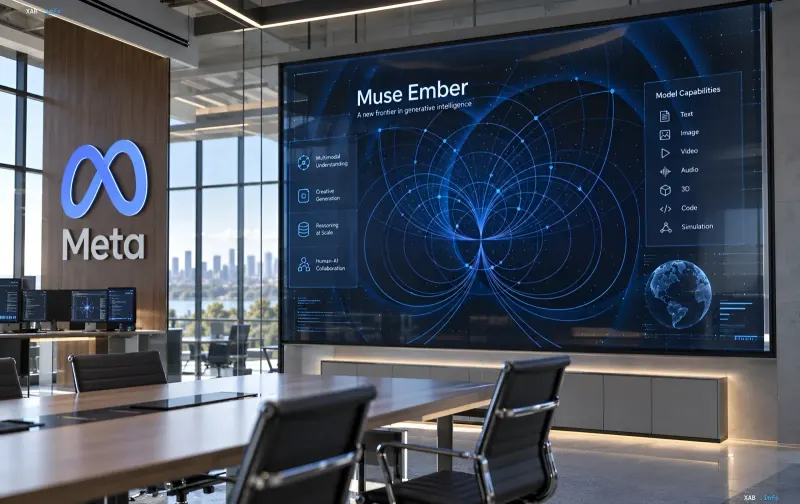
Meta has unveiled its new generative AI model, Muse Ember, which the corporation positions as a "new frontier in generative intelligence." According to the developers, the model is designed to handle complex logical tasks and manage the routine day-to-day work of AI agents. The key difference between Ember and other products in the lineup is its compactness: the company calls it the lightest and most efficient model in its family, making it an optimal tool for mass computing operations where speed and inference costs are critical.
A price that shifts the landscape
The main competitive advantage of Muse Ember is its cost: 10 cents per 1 million input tokens. This pricing makes the model significantly cheaper than its direct rivals—Anthropic Haiku and OpenAI Luna—and allows Meta to compete on price even with open solutions like DeepSeek V4.1 Flash and GLM 5.3 Flash. For developers who process large data streams, this means the ability to scale agents without a proportional increase in API costs.
"Brain + Hands" architecture
Meta recommends using Ember not as a standalone product, but in tandem with more powerful models—specifically, the flagship Meta Muse Wonder. In this configuration, the senior model acts as the "architect": it determines the sequence of actions and formulates instructions for solving the problem, while Ember performs the bulk mass labor according to the given algorithm. This division of roles allows for the combination of the flagship's reasoning quality with the low cost and high throughput of the compact model.
Multimodality without third-party services
To efficiently process large volumes of information, the model has been trained to work with various media types: text, images, video, audio, 3D content, code, and simulations. This allows AI agents to read and interpret information directly, without involving third-party services or additional models, which simplifies infrastructure and reduces latency. Declared capabilities also include multimodal understanding, creative generation, reasoning at scale, and human-AI collaboration.
The fourth generation of the Muse family
Muse Ember is the fourth product in Meta's Muse family. The timeline of the line is as follows: in April, the company released the mid-range model Spark, in August, its open-source version Glimmer, and in October, the flagship model Wonder. Thus, by November 2026, Meta has formed a full spectrum of models—ranging from compact and cheap to flagship—covering various use cases and developer budgets.
Strategic context: the bet on AI agents
The emergence of Ember fits into Meta's broader plan to monetize artificial intelligence. The consumer assistant Muse Agent, launched in September, has already received expanded functionality, including new Spaces modes and video chat. The combination of the cheap "worker" core Ember, the flagship reasoning Wonder, and the growing consumer agent allows the company to aim for AI earnings comparable to revenues from Facebook and Instagram, shifting the focus from advertising to paid intelligent services.