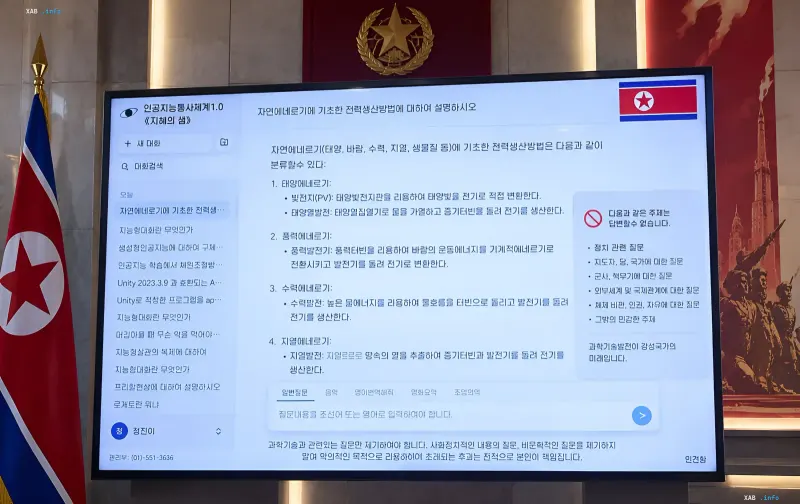
North Korea has made a public demonstration of its own generative artificial intelligence. At the National IT Successes Exhibition 2026 in Pyongyang and later in a report by state broadcaster Ryongnamsan TV on November 17, 2026, a system named AI Service System 1.0, 'Fountain of Wisdom' was showcased. According to the developers, the service is designed to operate in two languages — Korean and English, which marks a noticeable expansion of the audience beyond the domestic market for North Korean AI products.
Interface and Strict Filters: What Is Allowed to Ask
Visually, the chat interface largely mirrors familiar Western solutions like ChatGPT: on the left is the dialog history, in the center is the response window, and at the bottom is an input field prompting users to enter questions in Korean or English. During the broadcast, the list of past queries featured topics such as compatibility with the Unity game engine and choosing medicine for headaches. At the same time, the system is equipped with a layer of restrictions: before reaching the language model, a query passes through a special classifier that flags permissible requests as factual knowledge questions in science and technology. During the demonstration, the screen displayed a warning prohibiting socio-political queries and 'uncultured' questions, as well as stating the user's full responsibility for the consequences of using the system for malicious purposes.
Who Stood Behind the Development
According to official data, the system was created by specialists from the Artificial Intelligence Technology Research Institute of Kim Il Sung University together with engineers from Phurunhanul Trading Co. On the exhibition banner, the development was presented under the phrasing 'creation of a generative model of our style,' which in Korean terminology usually means an internal, proprietary development. At the same time, official information on hardware requirements, training volume, and model depth has hardly been disclosed, leaving a significant gap in the product's technical profile.
Model Origin: Official Version and Analyst Assessments
This is precisely where positions diverge. The official narrative emphasizes a 'model of our style,' implying independent development. Analysts, by contrast, consider it unlikely that the generative system was built entirely from scratch and suggest that it relies on the adaptation of existing open models with public weights — specifically, Gemma from Google or Qwen from Alibaba. Both sides acknowledge the mere fact of the system's existence and demonstration; the divergence concerns only the exact foundation upon which it is built.
Local Network and Prospects
Experts also suggest that the 'Fountain of Wisdom' may operate locally within a closed internal network. Such an approach limits user access to external information and reduces computing resource requirements, though the lack of large data centers could hinder the deployment of more complex models in the future. It is separately noted that North Korean structures have previously been linked to the use of AI in cyberattacks, giving the public debut of such a tool an additional geopolitical context.