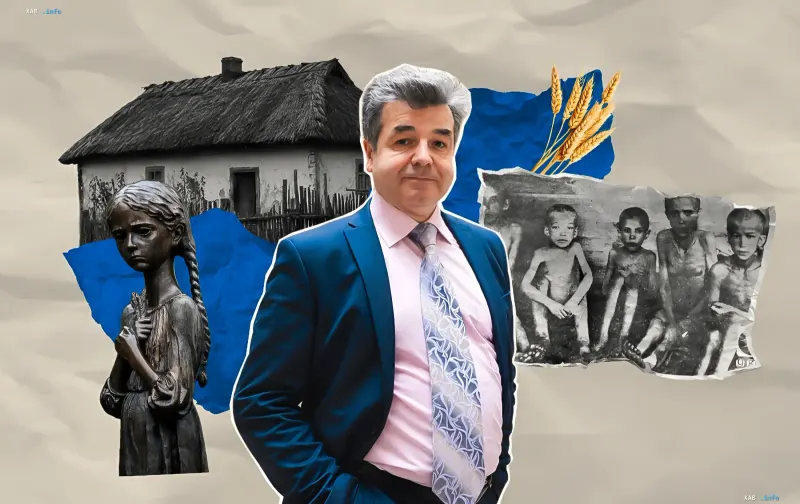
The Holodomor of 1932–1933 remains one of the largest crimes committed by the Soviet regime against the Ukrainian people. According to Andrii Kozytskyi, a senior researcher at the National Museum of the Holodomor-Genocide, Moscow did not merely confiscate grain — it blocked entire settlements, banned people from leaving, and purposefully exacerbated the famine in territories populated by Ukrainians. In an interview with RBC-Ukraine, Kozytskyi explained which specific documents confirm the genocidal nature of these events, how the Kremlin's policy toward Ukraine differed from other regions of the USSR, and how modern estimates of the death toll are formed.
Eighty Resolutions as an Evidentiary Base
According to Kozytskyi, back in 2009–2010, when the Security Service of Ukraine (SBU) was investigating the genocide case, investigators gathered about 80 resolutions and decisions of the highest governing bodies of the USSR and the UkrSSR, indicating that the Kremlin's actions deliberately intensified the famine in Ukraine in 1932–1933. Crucially, these decisions applied exclusively to Ukraine and Ukrainian-populated areas of the North Caucasus, primarily the Kuban region. There were no similar directives for other regions of the Soviet Union. Kozytskyi emphasizes that this refutes the thesis that “the famine was the same everywhere”: the Soviet leadership aimed to purposefully persecute Ukrainians and create conditions leading to their extinction, which, under the definition of the Convention on the Prevention and Punishment of the Crime of Genocide, qualifies as genocide.
The Decree of December 14, 1932, and the National Component
One of the key documents cited by the researcher is the decree of the Central Committee of the All-Union Communist Party (Bolsheviks) and the Council of People's Commissars of the USSR “On Grain Procurement in Ukraine, the North Caucasus, and the Western Region” dated December 14, 1932. In it, alongside the task of completing grain collection, it is explicitly stated that it is necessary to “cleanse” party and Soviet organizations of “Petlyurite” and other “bourgeois-nationalist elements.” The same decree ordered the deportation of the village of Poltavskaya in the Kuban to the northern regions of the USSR. Kozytskyi notes that the document clearly links the organization of the famine with the national component: Ukrainians were to be punished with hunger while simultaneously clearing Ukrainian lands of “Petlyurites” and “nationalists.”
“Black Boards”: Village Blockades and Travel Bans
On December 6, 1932, Vlas Chubar and Stanislav Kosior signed a joint resolution of the Council of People's Commissars of the UkrSSR and the Central Committee of the CP(b)U “On Entering Villages Maliciously Sabotaging Grain Procurement onto 'Black Boards.'” The mechanism was harsh: blockaded villages were completely deprived of bread and goods, and their residents were forbidden to leave the territory. The initial document mentioned six Ukrainian villages, but subsequently the number of settlements punished in this manner reached hundreds. Kozytskyi emphasizes that the practice of “black boards” did not reach such proportions in other regions of the USSR. Furthermore, during the Holodomor, Ukrainians were forbidden to leave the territory of the UkrSSR, which, according to the researcher, deprives the argument of a “uniform famine” across the entire Union of any logic: if the famine had indeed been the same everywhere, a ban on traveling to Belarus or Russia would have had no logical explanation.
The Goal Was Not Physical Destruction of the Nation, but Liquidation of Its Leading Stratum
Kozytskyi draws attention to the fact that the ultimate goal of Stalin's leadership was not the liquidation of all Ukrainians — the nation was too numerous to destroy entirely — but rather the extermination of the leading stratum of Ukrainians capable of organizing Ukraine's independence from the USSR. According to the researcher, this particular feature of genocide was pointed out by Raphael Lemkin, a Jewish-American lawyer and the creator of the term “genocide” itself. In the short term, Kozytskyi notes, the Bolsheviks achieved their goal: in the mid-20th century, Ukraine's path to independence was delayed. However, independence was ultimately achieved, and, as the scholar emphasizes, today Ukraine is forced to confront the very same enemy that tried to eliminate it as a nation.
From Estimated Figures to Archival Data
The question of the exact number of Holodomor victims remains a subject of ongoing scientific research. Kozytskyi explains that during the events of 1932–1933, the authorities did not keep a death registry and subsequently attempted to conceal the real number of casualties. The initial estimates of the death toll were speculative and not based on documents or statistical studies. Following the proclamation of Ukraine's Independence, archives were opened, and systematic work with primary sources began. During the SBU investigation into the crime of genocide, specific factual circumstances recorded in documents of that time were established. It is upon this documentary base, according to Kozytskyi, that modern scientific estimates are built, which, unlike early rough figures, have archival confirmation.