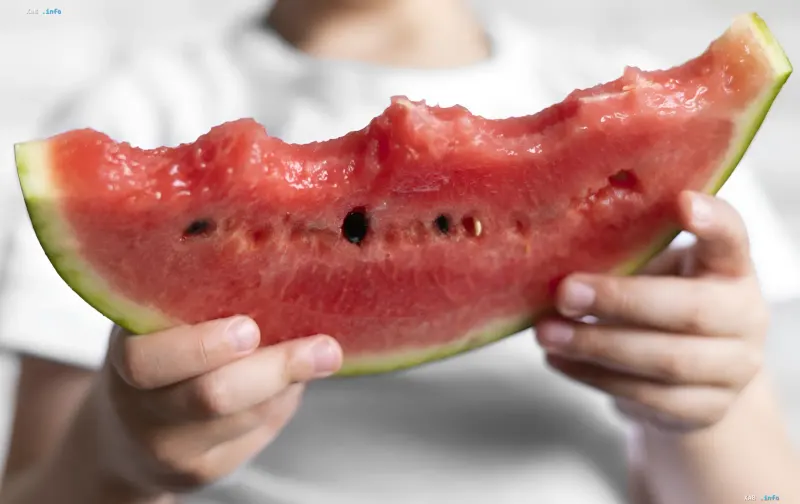
Watermelon is a berry that is rightfully considered one of the main symbols of summer. However, choosing a truly ripe, juicy, and sweet fruit at the market is not always simple. Buyers often hear from sellers the advice to look for 'girls', claiming they are sweeter than 'boys'. But is this really true?
Experts from Styler explain what real signs to pay attention to in order to guaranteedly enjoy a juicy berry, and dispel popular myths.
Forget about size and color
When choosing a watermelon, you should not focus only on its dimensions or the saturation of its color. It is much more important to pay attention to the spot on the side of the fruit — this is the place where it lay on the ground. In a ripe watermelon, it usually has a yellow or creamy shade. If the spot is almost white, it may mean that the fruit was harvested too early.
Weight and skin condition
Another important criterion is weight. A ripe watermelon should be heavy enough for its size, as there is a lot of juice inside. Therefore, if you are choosing between two fruits of approximately the same size, it is better to take the one that seems heavier.
It is also necessary to assess the skin of the berry. It should be firm, without soft areas, deep cracks, or other damage. In a ripe watermelon, the surface often looks more matte than shiny. You should also pay attention to the stem: dry and brownish often indicates ripeness, while bright green may indicate that the watermelon was picked recently and may not have had time to ripen.
The myth of 'girls' and 'boys'
Probably everyone who has ever chosen a watermelon at the market has heard about 'girls' and 'boys'. According to popular theory, 'girls' have a round shape and a large round spot at the bottom, while 'boys' have a more elongated shape and a smaller spot. It is believed that it is precisely the 'fair representatives' of the melon family that are sweeter, juicier, and have fewer seeds.
However, in reality, such a division between watermelons does not exist. This is just a folk myth that has been passed from one buyer to another for years. Watermelons do not have 'male' and 'female' fruits, and the shape and size of the spot do not determine their sweetness. A large round spot does not guarantee that the watermelon will be sweet, and a 'pseudo-boy' with an elongated shape can turn out to be much tastier.
Geography of taste: Ukraine and imports
The place of cultivation can indeed affect the taste of the watermelon. This crop loves a lot of sun and heat, so it feels better in regions with a long hot summer. This is why in Ukraine, watermelons from the southern regions, in particular Kherson and Odesa regions, are traditionally famous. There is a favorable climate for them: many sunny days and enough heat for the fruits to ripen well.
As for Zakarpattia watermelons, they can also be very tasty, but it all depends on the specific year, variety, and growing conditions. If the summer was warm and sunny, local fruits can certainly delight with a sweet taste.
The situation with imported watermelons is similar: on the shelves you can find fruits from different countries, and the fact of import itself does not mean that they will be better or worse. For example, a watermelon grown in a warm sunny region can be very sweet. But if it was harvested while still unripe so that it would better withstand transportation, the taste may not be so rich.
If choosing between a Ukrainian and an imported watermelon, experts recommend paying attention not only to the label but also to the seasonality, ripeness, and appearance of the fruit. In the midst of the Ukrainian season, local watermelons often have an advantage, as they do not need to travel a long way to the store.
The main rule of choice
Many check the watermelon by tapping it. They say that a ripe fruit should emit a ringing, elastic sound. But this method is indeed subjective and does not always meet buyers' expectations.
The simplest rule: a good watermelon should be heavy, with firm skin, without damage, and with a noticeable yellow spot where it lay. If all these signs match, the chances of getting a juicy and ripe fruit are significantly higher. Styler recommends not choosing watermelons solely on the principle of 'girl or boy', but to evaluate several of the indicated signs at once — this way you will have a much greater chance of finding a truly ripe and sweet watermelon.